
What it is
Overview
XGBoost is a gradient boosting library designed for data scientists and machine learning engineers who need to build high-performance predictive models. The tool addresses the challenge of creating accurate machine learning models efficiently, particularly when working with large datasets that require scalability and optimization. Users working on regression, classification, ranking problems, or custom objectives can utilize XGBoost to train models that have proven their effectiveness in competitive data science environments.
At a glance
Usability & Quality overview
Best for
- tabular machine learning
- classification
- regression
Watch out for
- Hyperparameter tuning can be time-consuming
- Performance can drop on low-signal or simple datasets
- Overfitting is a recurring concern in some domains
Real product, not a wrapperIndependent product
XGBoost is a foundational machine learning library with proprietary algorithmic innovations in gradient boosting — regularization techniques, parallel tree construction, and sparse data handling that differentiate it from generic implementations. It's not a wrapper around another model; it IS the specialized implementation that powers tabular ML workflows.
Strong evidenceQuality score
XGBoost is a top choice for tabular machine learning, but tuning and overfitting take care.
This score is our editorial judgment, computed automatically from the sources, weights, and dates shown above. It reflects the data we could verify as of November 16, 2026, not a guarantee or statement of fact about XGBoost. Third-party ratings and quotes belong to their original platforms and authors. Thin data lowers our confidence label, and we say so instead of guessing. Work on XGBoost? Dispute any datapoint and we will review it, publish your response, and correct verified errors.
PricingFree
Individual plan details haven't been verified yet — they'll appear here on the next data refresh.
Community feedback
Aggregated reviews
Ratings and quoted comments below are aggregated from third-party sources and reflect those users' views, not SearchTools.ai's.
What reviewers talk about
themes inside the Sentiment pillar — not score ingredients
61Output Quality14 mentions
“Been working on an ML system for crypto perpetuals trading. Using LightGBM + XGBoost ensemble with walk-forward validation. Key learnings: - Fear & Greed Index is the most predictive feature (even beats RSI) - Walk-forward validation is essential - my first model was 70% backtest but 42% live - 5x leverage max, ATR trailing stops Getting about 64% accuracy on out-of-sample data. Anyone else doing ML for crypto? What features work best for you?”
“LGBM is almost always better than XGB. Sometimes CB, if you have a lot of categorical data and not that many missing values. NNs are almost always bad (by bad I mean worse than GBM) with tabular data. One would use NNs for panels only in two cases: there is a need for online learning (but even in this case something like LR with SGD could be preferential) or multiple targets should be predicted.”
“I participate in about 6-7 Kaggle competitions, half of which were tabular, I hope that I can give some insights. For some reason, tree-based model outperformed DL model in every competition that I participated. Some include time-series, drug characteristics development, etc. Currently I see the rise of Transformer-based and Autoencoder models (in here), but we will have to see. That being said, how to define "tabular" data? Of course data from SQL database can be considered tabular, but ima”
“Tree based methods in general perform well on tabular data. That's why XGBoost performs well. I'm sure you would obtain similar performance if you had used Catboost, or even a random forest. But are they efficient to create? The benefit of methods like Neural networks is that they are "fire and forget" and play well with technologies like AutoML (see Autokeras), perform automatic feature engineering, and handle high dimensional data easily through methods like embeddings whereas tree methods”
Watch & learn
Video content
YouTube YOUTUBE608 views
TabPFN vs XGBoost: can a foundation model beat a tuned XGBoost with zero tuning?
prior-labs26 days ago
 YOUTUBE592 views
Google's TabFM Beats XGBoost Without Training
forwardpasstech15 days ago
 YOUTUBE254 views
Gradient Boosting & XGBoost Explained | How Powerful ML Models Actually Learn
TheComputerLayer19 days ago
 YOUTUBE148 views
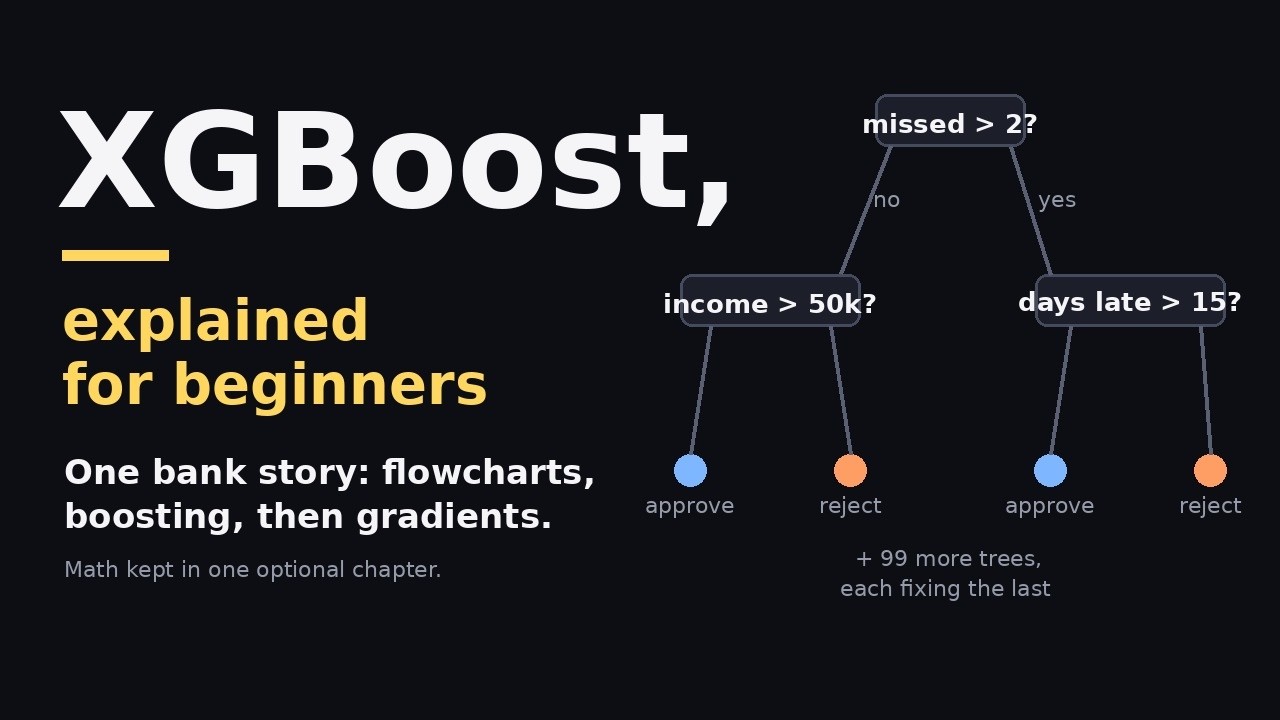
How XGBoost Actually Works - Visual Explainer for Beginners
rushil_arora19 days ago
 YOUTUBE362 views
Tabular Foundation Models Explained: Is XGBoost Still Relevant? | AI
Noteeklabs19 days ago
 YOUTUBE131 views
How Simple Decision Trees Beat Giant AI Models on Tables
AttentionSpan00912 days ago
Capabilities
Key features
Developer Tools
Provides utilities that help programmers build, test, and ship software faster
The honest take
What users love & flag
Distinct themes surfaced across user reviews — each grounded in real review text, ranked by how often it comes up.
Questions
Frequently asked
What is XGBoost?
XGBoost is an open-source gradient boosting library designed for building high-performance machine learning models for regression, classification, and ranking problems. It's widely used by data scientists and machine learning engineers, with a proven track record of winning numerous data science competitions and being deployed in production environments by multiple companies.
Is XGBoost free to use?
Yes, XGBoost is an open-source project that is free to use. It's accessible across all major platforms including Windows, Linux, macOS, and cloud computing environments without any licensing costs.
What programming languages does XGBoost support?
XGBoost provides APIs for multiple programming languages including C++, Python, R, Java, Scala, and Julia. This multi-language support allows developers to integrate XGBoost into their existing data science workflows regardless of their technology stack.
Can XGBoost handle large datasets?
Yes, XGBoost scales from small datasets to beyond billions of examples. It supports distributed training across multiple machines using integration with systems like Apache Spark and Dask, allowing it to handle datasets that exceed single-machine memory constraints.
What types of machine learning problems can XGBoost solve?
XGBoost can solve regression problems, binary and multi-class classification tasks, ranking problems for search and recommendation applications, and custom user-defined objectives. The library implements gradient boosting algorithms with an optimized backend designed for performance across these different problem types.
How does XGBoost perform in competitive machine learning?
XGBoost has a strong track record in competitive machine learning, having won numerous data science and machine learning challenges. This battle-tested performance in competitions demonstrates its effectiveness at building accurate predictive models and has contributed to its widespread adoption in production environments.
Can I use XGBoost for distributed training?
Yes, XGBoost supports distributed training that allows you to scale model training across multiple machines. It integrates with distributed computing systems like Apache Spark and Dask, making it suitable for training on large datasets that require multiple machines to process efficiently.
What makes XGBoost different from other gradient boosting libraries?
XGBoost distinguishes itself through its optimized backend that delivers strong performance even with limited computational resources, its proven track record in winning data science competitions, and its flexible deployment options across multiple platforms and programming languages. The combination of production reliability, scalability to billions of examples, and distributed training capabilities sets it apart in the gradient boosting space.
Compare XGBoost
Compare with another toolMore Like This
