
What it is
Overview
Weights & Biases tracks machine learning experiments, versions models, and monitors AI applications in production. Data scientists and ML engineers use it to log training runs, compare hyperparameters, and visualize model performance across frameworks like PyTorch, TensorFlow, and Hugging Face. The tool handles the bookkeeping that comes with iterative model development — what worked, what didn't, and why. Reviewers consistently praise the minimal code integration required to start logging experiments.
At a glance
Usability & Quality overview
Best for
- ML experiment tracking
- model/version comparison
- team collaboration around training runs
Watch out for
- UI performance complaints
- Python SDK documentation friction
- pricing at larger team scale
Real product, not a wrapperIndependent product
Weights & Biases offers proprietary ML experiment tracking with specialized workflow automation that chains multiple training steps. Deep integrations with PyTorch, TensorFlow, and Hugging Face transform the ML development experience beyond what general AI tools provide.
Strong evidenceQuality score
Weights & Biases A strong ML experiment tracking and collaboration platform
This score is our editorial judgment, computed automatically from the sources, weights, and dates shown above. It reflects the data we could verify as of September 1, 2026, not a guarantee or statement of fact about Weights & Biases. Third-party ratings and quotes belong to their original platforms and authors. Thin data lowers our confidence label, and we say so instead of guessing. Work on Weights & Biases? Dispute any datapoint and we will review it, publish your response, and correct verified errors.
Plans
Pricing
How free is free?
Genuinely free
Full ML experiment tracking for personal use; Pro $60/mo for teams
What you get for free
- AI application evaluations and tracing
- Model experiment tracking with metrics logging
- AI assets registry & lineage tracking
- Scorers for model evaluation
- Community support
- Integration with PyTorch Lightning and other ML frameworks
Behind the paywall
- Unlimited teamsPro
- Team-based access controlsPro
- Service accountsPro
- Priority supportPro
- CI/CD automationsPro
- Slack/email alertsPro
- HIPAA complianceEnterprise
- SSO and automated user provisioningEnterprise
Community feedback
Aggregated reviews
Ratings and quoted comments below are aggregated from third-party sources and reflect those users' views, not SearchTools.ai's.
What reviewers talk about
themes inside the Sentiment pillar — not score ingredients
71Output Quality17 mentions
“I use WandB in my job multiple hours per day. It's the most feature-complete thing for this application out there, but its performance is soooooo gratingly bad.”
“With how popular LLMs are, its mindboggling how wandb lacks a feature for continuously logging text generation samples during training. I'm aware they suggest using tables for logging text data, but from my understanding they are not designed to be updated. So each time you want to log new text samples, you have to create a new table. And for some reason the feature request of this issue is closed due to stale , and the community is doing gymnastics to overcome this problem.”
“Wandb only logs what you tell it to log. The data hosted on their server is opt-in, meaning you explicitly log what you want when you use their API. If you don't trust any third party with your process, the local setup seems pretty straightforward (docker container), info at https://docs.wandb.ai/guides/hosting/basic-setup. I did use some other experiment tracking software and found wandb to be easier and full of useful features. Granted I didn't try MLFlow, but wandb had almost everything I nee”
“W&B is fantastic and comet.ml is even better if you're trying to do ML experiments at scale. like kubernetes, docker, a linter, git, pull requests, pre-commit hooks: you're not going to see the value at small scale. If you're just one person you probably do think "this sucks" and thats ok. then you try and have 100 engineers working on the same codebase and you go OH. YEAH. LETS HAVE A LINTER. Langchain just sucks. Its truly awful. And its also not the type of tool like linters or experiment tra”
63Ease of Use23 mentions
“What stands out most about Weights & Biases is how seamlessly it tracks ML experiments through a clean, intuitive UI/UX. It integrates effortlessly with frameworks like PyTorch and Hugging Face, which makes real-time performance monitoring and fast, reliable data logging feel almost automatic. Onboarding is quick and well supported by strong documentation, so it’s easy to get up and running without friction. The AI intelligence features also help keep artifact management organized and make hyper”
“I keep bumping into these tools (weights & biases, langfuse, langchain) and honestly I’m not sure if it’s just me but the UX feels… bad? Like either bloated, too many steps before you get value, or just generally annoying to learn. Curious if other engineers feel the same or if I’m just being lazy here: • do you actually like using them day to day? • if you ditched them, what was the dealbreaker? • what’s missing in these tools that would make you actually want to use them? • does it feel like t”
“Weights & Biases makes MLOps and experiment tracking feel effortless, with only minimal code required to get started (wandb.init()). Its real-time, interactive dashboards deliver immediate and detailed visualizations of training loss curves, the impact of hyperparameters, and system resource utilization (GPU/CPU). On top of that, robust artifact versioning and seamless integrations with frameworks like PyTorch, Hugging Face, and TensorFlow make model reproducibility and team-wide collaboration e”
“I primarily use Weights & Biases to track and compare machine learning experiments, monitor training metrics in real time, and manage model versions. I really like how it solves the challenge of keeping experiments organized and reproducible, with everything logged automatically. What I like most about Weights & Biases is how effortless it makes experiment tracking and visualization. The interactive dashboards, real-time training metrics, hyperparameter comparison tools, and artifact management ”
83Trust derived from dimensions + predator detectionview math
A composite of the quality dimensions weighted by mention volume, then capped by predator / abuse-detection rules.
Reasoning
Watch & learn
Video content
YouTube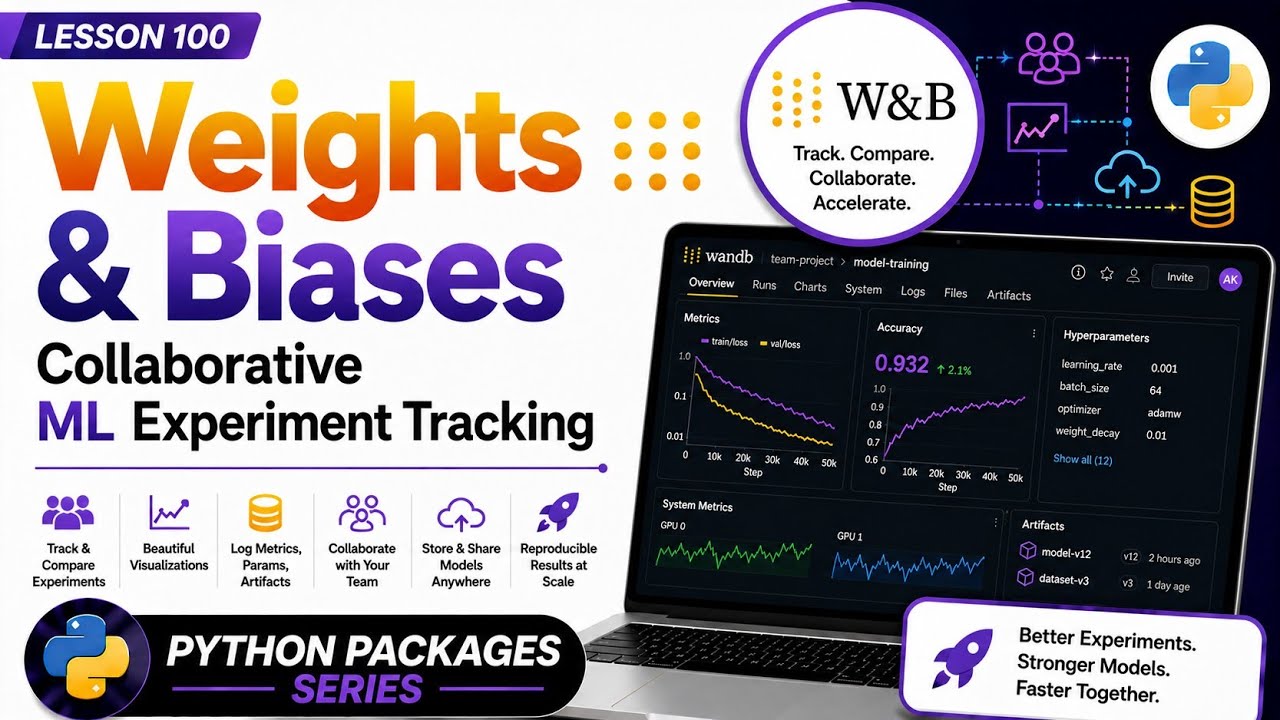 YOUTUBE22 views
L100 | Weights & Biases: Collaborative ML Experiment Tracking | Python Packages Series | Uplatz
Uplatz27 days ago
 YOUTUBE7 views
LLM Observability: 8 Tools Compared (2026)
AIEvals-k9j15 days ago
Capabilities
Key features
Developer Tools
Provides utilities that help programmers build, test, and ship software faster
Workflow Management
Automates multi-step processes and routes tasks across your tools and team
The honest take
What users love & flag
Distinct themes surfaced across 78 reviews from 3 sources — each grounded in real review text, ranked by how often it comes up.
Questions
Frequently asked
What is Weights & Biases?
Weights & Biases is a unified AI developer platform that tracks experiments, versions models, and monitors AI applications from development to production. It addresses the fragmented toolchain problem by combining traditional ML workflows and modern GenAI development in a single platform, targeting AI developers, data scientists, ML engineers, and research teams who need to manage complex AI workflows at scale.
Is Weights & Biases free?
Yes, Weights & Biases offers a free plan designed for personal development that includes 5GB storage, AI application evaluations, experiment tracking, model registry, and community support. For professionals, the Pro plan starts at $60 monthly with unlimited teams and 100GB storage, while Enterprise plans offer custom pricing with advanced security features.
What's the difference between W&B Models and W&B Weave?
W&B Models is designed for traditional machine learning workflows, focusing on experiment tracking, hyperparameter optimization, and model management. W&B Weave is specifically built for generative AI applications, providing LLM call tracing, model performance evaluation, and production monitoring for AI applications.
What machine learning frameworks does Weights & Biases integrate with?
Weights & Biases integrates with popular frameworks including PyTorch, TensorFlow, Transformers, LangChain, and LlamaIndex. The platform supports simple code integrations that automatically capture model training runs and log metrics, hyperparameters, and model artifacts.
How does Weights & Biases handle hyperparameter optimization?
Weights & Biases provides automated hyperparameter optimization through a feature called Sweeps, which includes automated sweep configurations and visualization tools. This allows users to systematically explore different hyperparameter combinations and visualize the results to find optimal model configurations.
What security and compliance certifications does Weights & Biases have?
Weights & Biases maintains enterprise-grade security certifications including SOC 2, HIPAA, and ISO 27001 compliance. The Enterprise plan specifically offers additional security features like single tenant options, customer-managed encryption, SSO, automated user provisioning, and secure private connectivity.
Can I monitor GenAI applications in production with Weights & Biases?
Yes, through W&B Weave, you can monitor GenAI applications in production by tracing LLM calls and capturing inputs, outputs, and metadata. The platform also provides evaluation frameworks for testing AI model performance using rigorous testing and LLM-as-a-judge metrics.
What platforms is Weights & Biases available on?
Weights & Biases is available as a web tool and also has an iOS app. The platform supports both cloud-hosted and privately-hosted deployments to accommodate different organizational requirements.
How much does storage cost beyond the included limits?
Storage overage costs $0.03 per GB beyond the included limits in your plan. The free plan includes 5GB of storage, while the Pro plan includes 100GB, and Enterprise plans have custom storage allocations.
Compare Weights & Biases
Compare with another toolMore Like This
