What it is
Overview
TensorFlow is an open-source machine learning framework for building, training, and deploying models across web, mobile, and edge devices. Google developed it as infrastructure software, not an AI product itself — it's the toolkit ML engineers use to create models from scratch. The 25 reviews skew toward production engineers who need deployment tooling like TensorFlow Serving and TFLite, not researchers prototyping in notebooks. This is a framework, not a wrapper or fine-tuned model.
At a glance
Usability & Quality overview
Best for
- production ML engineering
- deployment workflows
- teams prioritizing deployment over research ergonomics
Watch out for
- steep learning curve
- documentation inconsistency
- debugging friction
Real product, not a wrapperIndependent product
TensorFlow offers proprietary TPU integration and TensorFlow Lite for edge deployment that competitors don't have. It automates end-to-end workflows with tf.data pipelines and tf.estimators, integrates deeply with Google Cloud, mobile (Android/iOS), and web (TensorFlow.js), and provides specialized production tooling like model serving and distributed training. TensorBoard's visualization UX is a standout feature. Reviews confirm TensorFlow's production-deployment advantages over PyTorch, even as research has shifted to PyTorch.
Strong evidenceQuality score
TensorFlow Production-oriented ML framework with strong deployment tooling, but a steep learning curve and API churn.
This score is our editorial judgment, computed automatically from the sources, weights, and dates shown above. It reflects the data we could verify as of November 16, 2026, not a guarantee or statement of fact about TensorFlow. Third-party ratings and quotes belong to their original platforms and authors. Thin data lowers our confidence label, and we say so instead of guessing. Work on TensorFlow? Dispute any datapoint and we will review it, publish your response, and correct verified errors.
PricingFree
Individual plan details haven't been verified yet — they'll appear here on the next data refresh.
Community feedback
Aggregated reviews
Ratings and quoted comments below are aggregated from third-party sources and reflect those users' views, not SearchTools.ai's.
What reviewers talk about
themes inside the Sentiment pillar — not score ingredients
55Output Quality42 mentions
“Tensorflows tooling for deployments has been, and still in small parts is, more mature than PyTorch . At some point you'll want to switch from rapid innovation (which PyTorch excels at) to production, and Tensorflow has traditionally beaten PyTorch in that regard. The gap has closed significantly thanks to e.g. ONNX , but it still exists.”
“I keep seeing "Should I learn TensorFlow in 2026?" posts, and the answers are always "No, PyTorch won." But looking at the actual enterprise landscape, I think we're missing the point. Research is over: If you look at , PyTorch has essentially flatlined TensorFlow in academia. If you are writing a paper in TF today, you are actively hurting your citation count. The "Zombie" Enterprise: Despite this, 40% of the Fortune 500 job listings I see still demand TensorFlow. Why? Because banks and insuran”
“The reason you see it in job listings still is because hiring managers haven’t caught on that tensorflow is dead. It’s not the cobol of ML because ML systems don’t have a particularly long shelf-life. People are actively ripping out their TF stuff right now. More and more of the “TF has better production” stuff is getting eaten by ONNX bindings from traditional backend languages. Plus google’s gonna end-of-life TF, and then what do you do.”
“PyTorch also has the advantage of an integrated end-to-end ecosystem, and all this in a short amount of time.”
14Reliability11 mentions
“Robust, stable, reliable but not the simplest/most flexible option | Well suited: - pretrained BERT-base model ready to deploy - IoT with TensorFlow lite and the edge TPUs - Domain where datasets are available in Huggingface (e.g., medical model) <br><br> Less well suited: - Small project due to the complexity/less resource to learn - New model tends to use PyTorch | Pros: Model serving | Pros: Keras | Pros: Easy install/docker images | Pros: Lot of open source projects based on it (RL/GNN/etc.)”
“The reason you see it in job listings still is because hiring managers haven’t caught on that tensorflow is dead. It’s not the cobol of ML because ML systems don’t have a particularly long shelf-life. People are actively ripping out their TF stuff right now. More and more of the “TF has better production” stuff is getting eaten by ONNX bindings from traditional backend languages. Plus google’s gonna end-of-life TF, and then what do you do.”
“I would definitely NOT recommend starting a greenfield project in Tensor flow unless you explicitly need it for something like Edge deployment with TF-lite. Maintenance on it is clearly slowing down, performance isn't competitive anymore and the whole ecosystem is working against you. HuggingFace has also dropped their Tensor flow support too.”
“I'm trying to install it on Ubuntu 20.4, last time I had to install it was on Windows and I remember it being physically painful as well. I tried: Manually installing cuda/cudnn then tensorflow-gpu, but it was giving me errors related to the version of cuda, and then I couldn't even uninstall that version without messing up my drivers. Installing with conda, conda create --name tensorflow-gpu. This was really simple and I thought it was a life-saver because it did work, but when I started gettin”
42Support10 mentions
“Get Flowing with TensorFlow | TensorFlow is great for most deep learning purposes. This is especially true in two domains:<br>1. Computer vision: image classification, object detection and image generation via generative adversarial networks<br>2. Natural language processing: text classification and generation.<br><br>The good community support often means that a lot of off-the-shelf models can be used to prove a concept or test an idea quickly. That, and Google's promotion of Colab means that i”
“Apart from the hurdle of the complexity of statically compiled graphs, some of the pain points that ached TF were the incredibly scattered documentation and breaking API changes that further broke documentation over several minor versions. Learning TF1 was an incredible pain, because you'd find bad official documentation along with blog posts and tutorials that are not older than 2 months, that are still outdated because things moved so fast that there's now a new way of ingesting data, or batch”
“It seems to me that google has this "we write those frameworks for our own use, be thankful we even share them with you" approach in most of their open sourced code and documentation. Not to mention they are most likely optimizing their ML/DL frameworks for their homemade TPUs - to use and sell those more effectively. As most people have mentioned, thank god more and more papers are using pytorch now, as it's much easier to tinker with and get to know what's going under the hood of that paper'”
“I started with Keras (for my thesis, non-CS tho so nothing crazy) before it was officially part of TF, it did the job well but then I wanted to go a bit deeper with a framework that would offer me more control. TF 2.0 was my first choice since I used keras with TF backend and the fact that it's now officially the high-level API for TF. But... There weren't many tutorials specific to TF 2.0 and the changes from TF 1.x to 2.0 were massive. It was a huge mess for a new learner (now there are differ”
32Ease of Use51 mentions
“Playground.tensorflow.org Probably one of the best sites to explain how a neural network works visually without formulae. You can start with a simple example showing how the bare minimum number of parameters can’t solve even the basic datasets then incrementally show how a fully parametrised network solves the same dataset easily”
“I'm trying to install it on Ubuntu 20.4, last time I had to install it was on Windows and I remember it being physically painful as well. I tried: Manually installing cuda/cudnn then tensorflow-gpu, but it was giving me errors related to the version of cuda, and then I couldn't even uninstall that version without messing up my drivers. Installing with conda, conda create --name tensorflow-gpu. This was really simple and I thought it was a life-saver because it did work, but when I started gettin”
“I started with TF1 and absolutely hated it. It was not pythonic at all and I just couldn't get what I was doing. That is why I switched to PyTorch and I instantly loved the numpy-like API. Now that I am fluent with PyTorch, I don't want to switch back to TF2, which just became a poor clone of PyTorch...”
“I will answer as a person that generally prefers Tensorflow over Pytorch: Tensorflow had a pretty rough start. There was awkward tf.Session, than there was tf.Estimator, than there was no official high level API and everyone sort of wrote their own API (e. g. sonnet from Deepmind). This resulted not only in writing weird cpp like code in Python but also hurt reusability. Someone's repository used tf.Estimator and thus was unusable in your project that uses tf.Keras. Not to mention the he”
76Trust derived from dimensions + predator detectionview math
A composite of the quality dimensions weighted by mention volume, then capped by predator / abuse-detection rules.
Reasoning
Watch & learn
Video content
YouTube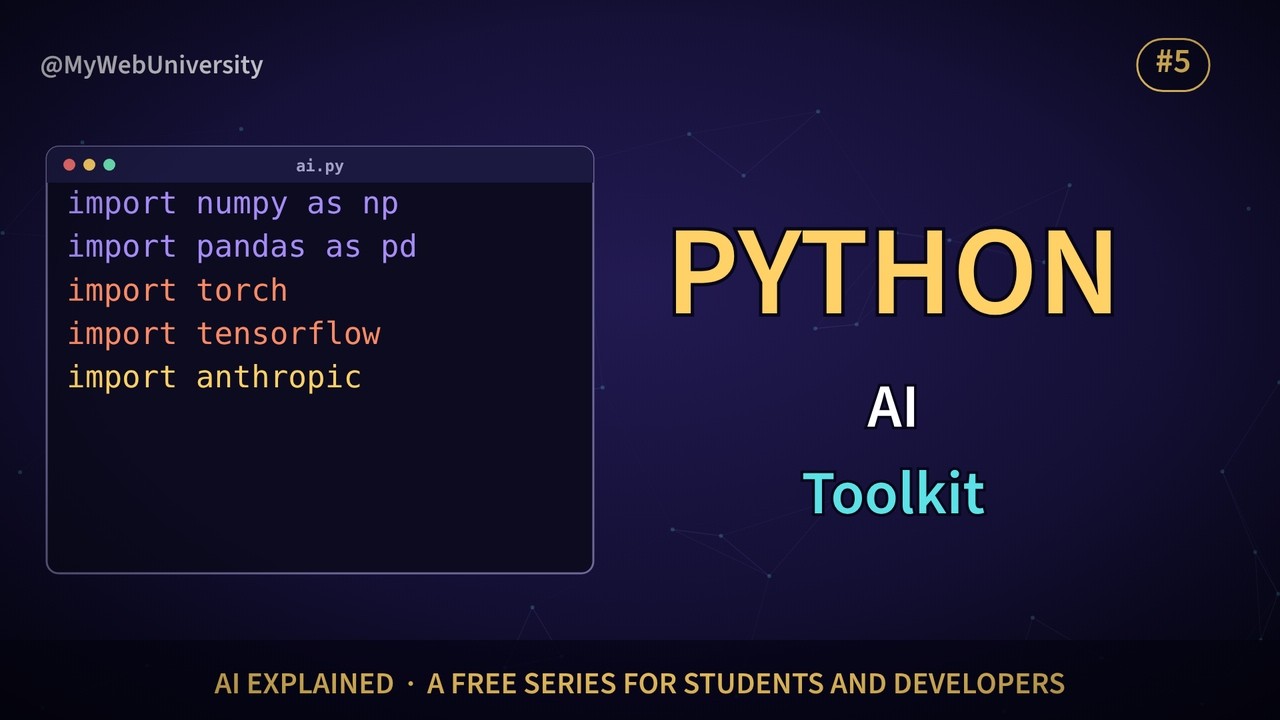 YOUTUBE35 views
The Python AI Toolkit: NumPy, pandas, scikit-learn, TensorFlow, PyTorch & LLM APIs | AI Explained #5
mywebuniversity26 days ago
Capabilities
Key features
Developer Tools
Provides utilities that help programmers build, test, and ship software faster
The honest take
What users love & flag
Distinct themes surfaced across 150 reviews from 2 sources — each grounded in real review text, ranked by how often it comes up.
Questions
Frequently asked
What is TensorFlow?
TensorFlow is an end-to-end open-source platform for building, training, and deploying machine learning models across diverse environments. It allows developers and data scientists to create AI-powered applications that run in browsers, on mobile devices, on edge hardware, or in production servers without rewriting code for each platform.
Is TensorFlow free to use?
Yes, TensorFlow is completely free and open-source. It's backed by Google and maintained by an active community, with no licensing costs for development or deployment.
What platforms can I deploy TensorFlow models to?
TensorFlow models can be deployed to web browsers using TensorFlow.js, mobile platforms including Android and iOS with LiteRT, edge devices like Raspberry Pi and Edge TPU, and production servers. This cross-platform capability means you can write your model once and deploy it anywhere without platform-specific rewrites.
What is tf.keras and how does it work?
tf.keras is TensorFlow's high-level API that provides an intuitive interface for defining and training machine learning models. It allows you to build models using sequential or functional approaches with components like Flatten, Dense, and Dropout layers, then compile them with optimizers like Adam for training.
Can TensorFlow handle graph neural networks?
Yes, TensorFlow includes TensorFlow GNN 1.0 specifically designed for building graph neural networks that analyze relational data and complex relationships between objects. This capability has applications in areas like traffic forecasting and medical discovery where understanding connections between entities is critical.
What is TFX and what does it do?
TFX (TensorFlow Extended) provides tools for creating production machine learning pipelines and implementing MLOps best practices. It helps you move from experimental models to production-ready systems with proper workflow management and operational practices.
How can I monitor my model training in TensorFlow?
TensorFlow includes TensorBoard, a visualization tool that lets you track model development and performance metrics throughout the training process. It provides real-time insights into how your model is learning and performing during training.
Can I use TensorFlow for reinforcement learning?
Yes, TensorFlow Agents is specifically designed for reinforcement learning applications. For example, Spotify uses TensorFlow Agents to design offline simulators and train agents for playlist generation, demonstrating its real-world production capabilities.
Does TensorFlow provide access to pre-trained models?
Yes, TensorFlow integrates with Kaggle Models which offers access to pre-trained models ready for fine-tuning and deployment. Additionally, it works with Keras 3 to run models like Gemma, Google's family of open language models, using a TensorFlow backend.
What is LiteRT in TensorFlow?
LiteRT (formerly TensorFlow Lite) is TensorFlow's solution for deploying models to mobile and edge devices. It handles deployment to Android, iOS, Raspberry Pi, and Edge TPU, enabling efficient on-device machine learning without requiring cloud connectivity.
Compare TensorFlow
Compare with another toolMore Like This
