
Rodin
What it is
Overview
A 3D model generator that outputs high-polygon assets from text prompts or reference images. Built on proprietary architecture, not a wrapper on existing models. The tool targets game developers and AR/VR studios who need production-ready meshes with 10M+ polygon counts. Early users praise the 4-5 second generation speed and surface detail quality in the Gen 2.5 release.
At a glance
Usability & Quality overview
Best for
- 3D game developers needing rapid prototyping
- Concept artists requiring region-based 3D edits
- AR/VR developers needing production-ready assets
Watch out for
- Struggles with extremely tiny, high-consistency details
- Very small community with limited long-term user reviews
- No critical user experiences or switching stories found
Real product, not a wrapperIndependent product
Uses proprietary 3D generation technology specifically designed for production-ready game and AR/VR assets, delivering high-polygon models in seconds - a specialized capability beyond general AI chatbots.
Strong evidenceQuality score
Rodin The most capable AI for production-ready 3D model generation and region-based editing, but limited community feedback on long-term performance.
This score is our editorial judgment, computed automatically from the sources, weights, and dates shown above. It reflects the data we could verify as of July 7, 2026, not a guarantee or statement of fact about Rodin. Third-party ratings and quotes belong to their original platforms and authors. Thin data lowers our confidence label, and we say so instead of guessing. Work on Rodin? Dispute any datapoint and we will review it, publish your response, and correct verified errors.
PricingUnknown
Individual plan details haven't been verified yet — they'll appear here on the next data refresh.
Community feedback
Aggregated reviews
Ratings and quoted comments below are aggregated from third-party sources and reflect those users' views, not SearchTools.ai's.
What reviewers talk about
themes inside the Sentiment pillar — not score ingredients
58Output Quality18 mentions
“I tested the retopology in the new Rodin Gen 2.5, and honestly, I was surprised by the result. The original mesh had almost 2 million polygons and pretty messy topology. Rodin managed to optimize it down to around 3,000 faces while keeping the overall shape readable and producing”
“Yep, but result still need fixing. Most major problem is topology which isn't so crucial for prints... Kidding. Back side is always a nonsense, mesh has a lot of unconnected vertices and holes, hard to fix cause even remeshed result is pile of poly shit.”
“Rodin presented their new Gen-2.5 model, and the preview looks genuinely impressive to me. The level of surface detail already feels much closer to a sculpting base than to a typical 3D GenAI result. Wrinkles, forms, and the overall structure look clean enough that I can easily s”
“Rodin has great topology . I use it by actually taking a single image and using nanobanana or kontext to generate imaginary angles. I prompt like “generate a front view,” generate a side view,” generate a back view.” When I add multiple images and references, it helps Rodin gener”
Watch & learn
Video content
YouTube YOUTUBE31.5K views
3D Modeling at the Speed of Thought: Hyper3D Rodin 2.5 Review
ThisisJames_crypto3 months ago
 YOUTUBE10K views
I Tested Rodin Gen 2.5 and the Results Were Insane | Hyper3D
LiquiAi3 months ago
 YOUTUBE11.4K views
Hyper3D Rodin Gen 2.5 | I Generated a 3D Model in 4 Seconds
TryThisAI13 months ago
 YOUTUBE7.9K views
This AI 3D Generator Is Mind-Blowing... (Rodin Gen-2.5 Review)
Trainer13003 months ago
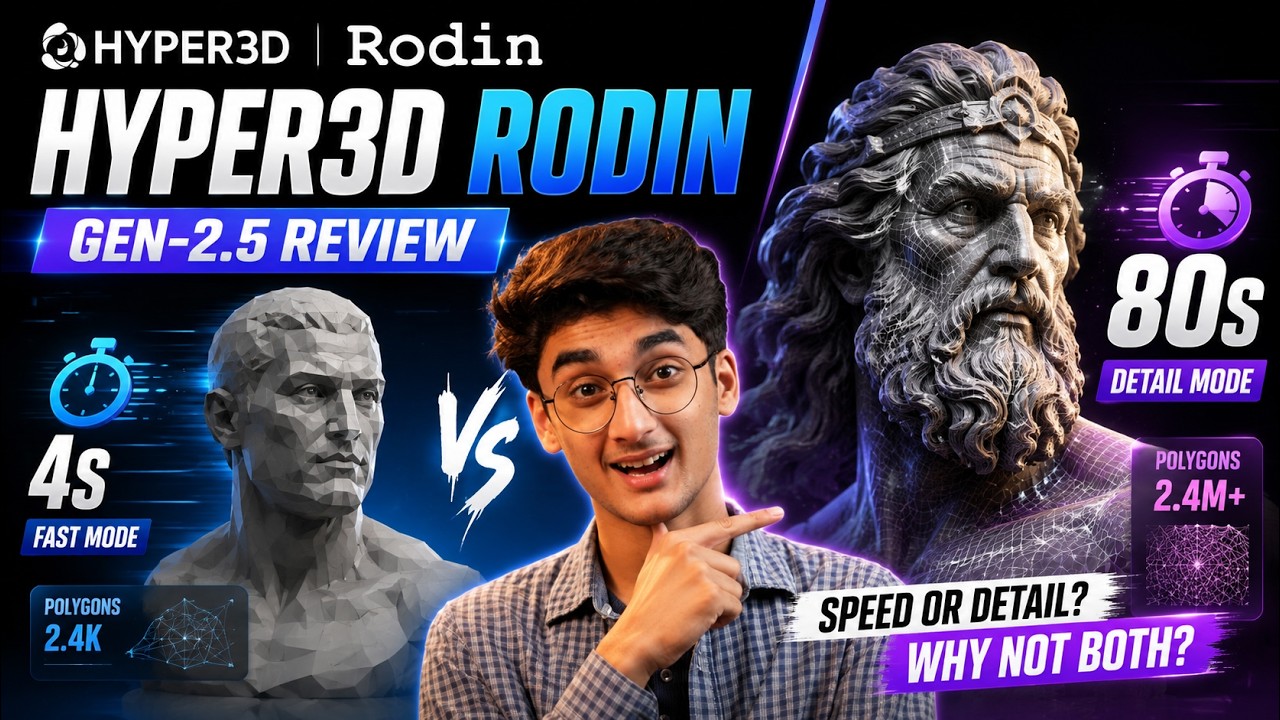 YOUTUBE5.6K views
This AI Actually Thinks Before Creating 3D Models?! Hyper 3D Rodin Gen 2.5 Review
Ahadanimates3 months ago
Capabilities
Key features
3D Model Generator
Creates three-dimensional models and assets from text prompts or reference images
Text to 3D
Generates three-dimensional models and shapes from your text descriptions
Image to 3D Model
Turns a flat image into a textured three-dimensional model you can use
The honest take
What users love & flag
Distinct themes surfaced across user reviews — each grounded in real review text, ranked by how often it comes up.
Questions
Frequently asked
What is Rodin?
Rodin is an AI-powered 3D model generator that creates detailed 3D assets from text prompts or images in just 4-5 seconds. It's designed for game developers, product designers, and digital artists who need production-ready 3D models without extensive 3D modeling expertise.
How fast can Rodin generate 3D models?
Rodin generates detailed 3D models in 4-5 seconds. The platform emphasizes speed while maintaining high output quality, supporting models with up to 10 million polygons for production use.
What input methods does Rodin support?
Rodin works with two primary input methods: text-to-3D generation where you describe your desired object, and image-to-3D conversion where you upload reference images, sketches, or product photos. The AI processes these inputs to generate complete 3D models with mesh geometry, textures, and materials.
What file formats can I export from Rodin?
Rodin supports multiple export formats including STL for 3D printing, GLB/GLTF for web and AR applications, FBX for game engines, OBJ for general 3D editing, and USDZ for Apple AR experiences. This makes it compatible with various workflows and applications.
Does Rodin integrate with popular 3D software?
Yes, Rodin integrates with industry-standard 3D applications through plugins for Blender, Unity, Unreal Engine, Maya, and other professional 3D software. This allows you to seamlessly incorporate AI-generated models into your existing workflow.
What advanced control features does Rodin offer?
Rodin includes Bounding Box ControlNet, Voxel ControlNet, and Point Cloud ControlNet for guiding the generation process. It also offers iterative splitting to break complex models into editable parts, partial editing capabilities, and Smart Low-Poly optimization for performance-optimized assets.
Is Rodin suitable for production work?
Yes, Rodin is designed for production environments and generates assets with clean topology and native 3D textures. It supports up to 10 million polygons and positions itself as a practical pipeline tool rather than just a prototype generator, making it suitable for professional 3D production workflows.
What platforms is Rodin available on?
Rodin is available as a web-based tool that you can access through your browser at hyper3d.ai. The platform also offers API access for programmatic 3D generation and enterprise features like team management and shared asset workspaces.
Compare Rodin
Compare with another toolMore Like This
