
What it is
Overview
A medical AI assistant that pulls from premium journals like NEJM, JAMA, and NCCN to answer clinical questions with source citations. Free for healthcare professionals. The 11.1 million monthly visits skew toward physicians, medical students, and nurse practitioners who want evidence-based answers without hunting through paywalled literature. Early reviewers praise the journal access and cite-backed responses as the main draw.
At a glance
Usability & Quality overview
Best for
- US primary care physicians
- hospitalists
- residents
Watch out for
- Must verify all references; not a diagnostic tool
- Struggles with complex or specialized inquiries
- Pharma-ad model may conflict with some clinical values
Built on another provider's modelResells a third-party model API
OpenEvidence provides access to premium medical literature from NEJM, JAMA, and other major journals that general AI tools don't have. It's specifically designed for healthcare professionals with medical evidence synthesis capabilities that go beyond what you'd get from ChatGPT or Claude for clinical questions.
Strong evidenceQuality score
OpenEvidence The best free AI for evidence-grounded clinical Q&A with primary literature citations, but accuracy errors and pharma-ad funding require physician verification.
This score is our editorial judgment, computed automatically from the sources, weights, and dates shown above. It reflects the data we could verify as of July 15, 2026, not a guarantee or statement of fact about OpenEvidence. Third-party ratings and quotes belong to their original platforms and authors. Thin data lowers our confidence label, and we say so instead of guessing. Work on OpenEvidence? Dispute any datapoint and we will review it, publish your response, and correct verified errors.
Plans
Pricing
How free is free?
Genuinely free
Free unlimited access for verified U.S. healthcare professionals
What you get for free
- Unlimited access to verified medical evidence from top journals
- AI-powered search and content generation
- Access to NEJM, JAMA, and other top medical journals
- Available to verified U.S. healthcare professionals only
Community feedback
Aggregated reviews
Ratings and quoted comments below are aggregated from third-party sources and reflect those users' views, not SearchTools.ai's.
What reviewers talk about
themes inside the Sentiment pillar — not score ingredients
40Output Quality98 mentions
“I’m a medical doctor in internal medicine and I use OpenEvidence all the time to confirm my conclusions. I absolutely love the application and really appreciate that a reference of sources is listed at the bottom!”
“Failed repeated requests for disclosure of financial conflict for physician advisors, collaborators, sponsors. Unsubstantiated claim as leading medical information platform”
“I have asked some specialized medical questions to help me answer as an attending physician at a major hospital. Unfortunately some of the answers are either watered down or not accurate enough which could affect patient care. You’lld think they’ll spend more time cursting thier ”
“I have ME/CFS and your application is suggesting graded exercise therapy. This ranges from not helpful to actually harmful. Any Dr giving out this as a treatment could be subject to malpractice. The PACE study was not properly peer reviewed before it was even published and debunk”
48Value & Pricingthin data · 9 mentions
“Open evidence is amazing. I use it every day for work as a primary care physician. It's also free!”
“OpenEvidence is not the end all be all. It's just free, got deals with major journals, and is capturing market share fast. https://arxiv.org/abs/2512.01191 It won't be free forever. It'll be $200 a month before you know it (once they nail more features down)”
“As a new NP... OE is a life saver... the fact that it is free is even better!”
“Obviously what everyone else said here: take it with a grain of salt but it’s a fantastic resource overall. And the CME you get tallies up fast and is free!!!!!!”
22Reliabilitythin data · 5 mentions
“OpenEvidence went from 358,000 consultations a month to 358,000 consultations a day in under a year. UpToDate took three decades to reach the penetration OpenEvidence has reached in roughly two years. That growth rate in a life-safety context, in a field where the gap between a c”
“Opened it today and it's like this. I'm really pissed off because it's the IA I use the most to fact-checl and search. I'm a 2nd year student btw. What do I do, find an (FREE) alternative or use a VPN? EDIT: I'm using Windscribe free vpn to change my IP to USA, Open Evidence work”
“I’ve used both products over time. For Doximity: answers are usually faster with more actionable answers. It also has a smoother product integration (move from Scribe to DoxGPT) as well as fully integrated telehealth services. The new Peer Check feature also helps provide some re”
“OpenEvidence is slow but has more accurate answers. DoxGPT for faster response.”
46Ease of Use15 mentions
“I used it to construct a table for me, that I can give as a hand out for parents for post tonsillectomy pain management for children. I asked it to list the median of the range of recommended dose for Tylenol and ibuprofen, into columns . And then create rows of children’s wei”
“There are many practice patterns. Generally, there is a big concern about “never-skilling” and mis-skilling where you either dont develop the knowledge base or reasoning to do medicine independent of these tools. I have noticed it makes residents lives easier to survive rounds, t”
“Heard this discussed amongst attendings. The attendings know you're using it, and they can tell you're using it too much to the point that you're offloading critical thinking. Expect hell if your AI-guided rounds don't match your ITE scores.”
“The challenge for me, and please give me some tips, is it takes me about 60 to 90 minutes to type in a complex case and all of the salient clinical points. I have some patients with multiple sets of labs, biopsy results, labs, a stack of subspecialty consults... and a set of pro”
66Trust derived from dimensions + predator detectionview math
A composite of the quality dimensions weighted by mention volume, then capped by predator / abuse-detection rules.
Reasoning
Watch & learn
Video content
YouTube YOUTUBE10.8K views
Is OpenEvidence Making Us Dumber?
ConanLiuMD2 months ago
 YOUTUBE21K views
Healthcare Professionals: You Must Use This Free AI
%EA%B9%80%EC%9B%90%EC%9E%A5%EC%9D%98%EC%84%9C%EC%9E%AC2 months ago
 YOUTUBE46 views
Specialized Clinical AI Just Lost its Best Arguments (Here's Whats Left) #aiinhealthcare
ReeWritesLLC2 months ago
 YOUTUBE26 views
OpenEvidence: The AI Tool 40% of U.S. Doctors Use Every Day
MedFYI2 months ago
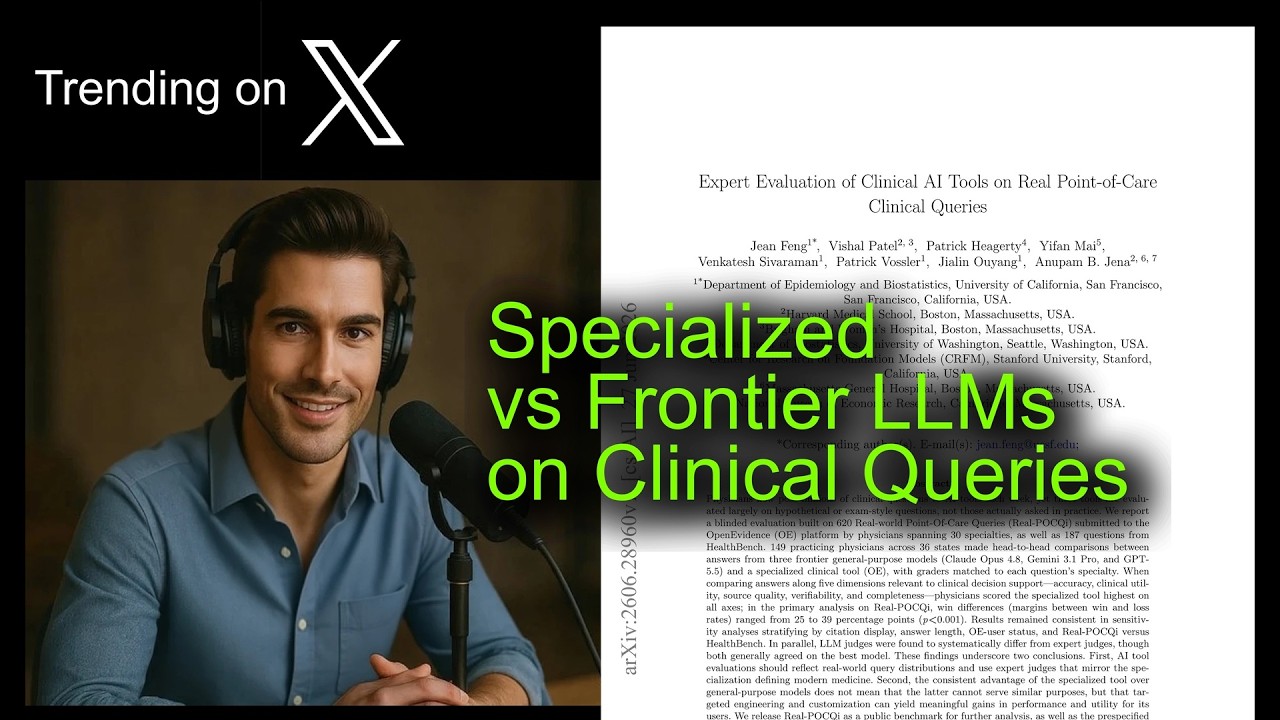 YOUTUBE25 views
Specialized vs Frontier LLMs on Clinical Queries
AIResearchRoundup2 months ago
 YOUTUBE7 views
1 Million Doctor Searches Per Day: The AI Clinical Tool Transforming Medicine | Dr. Melvin Speisman
disruptive-doctors2 months ago
Capabilities
Key features
Healthcare & Medical Assistant
Supports clinical documentation, triage, and health questions with AI assistance
Search Engine
Answers questions by searching the web and synthesizing results with sources
Content Generator
Produces written content like articles, posts, and copy from brief prompts
Research Tool
Gathers, searches, and organizes sources to help you investigate a topic
The honest take
What users love & flag
Distinct themes surfaced across 15.3K reviews from 2 sources — each grounded in real review text, ranked by how often it comes up.
Questions
Frequently asked
What is OpenEvidence?
OpenEvidence is an AI-powered platform that provides healthcare professionals with direct access to verified medical evidence from top journals like NEJM, JAMA, and Cochrane reviews. The platform allows clinicians to search, generate content, and access peer-reviewed medical information through official partnerships with leading medical publishers and organizations.
Is OpenEvidence free to use?
Yes, OpenEvidence is completely free for verified U.S. healthcare professionals with unlimited access to all features. However, you must be a verified healthcare professional in the United States to create an account and use the platform.
What medical journals and sources does OpenEvidence access?
OpenEvidence has official partnerships with major medical publications including The New England Journal of Medicine (NEJM), JAMA and the JAMA Network specialty journals, the National Comprehensive Cancer Network (NCCN), and Cochrane Systematic Reviews. It also includes content from medical societies like the American College of Cardiology (ACC), American Diabetes Association (ADA), and American Academy of Family Physicians (AAFP).
What can I do with OpenEvidence?
You can write evidence-based home care instructions, generate medical tables and data summaries, calculate clinical risk scores using validated algorithms, and access NCCN Guidelines Treatment Algorithms for cancer care. The platform also allows you to search full-text clinical findings and create HIPAA-compliant medical documentation for patient care.
Is OpenEvidence HIPAA compliant?
Yes, OpenEvidence is designed to be HIPAA compliant for use in clinical settings. This means healthcare professionals can safely use the platform as part of their patient care workflow while maintaining compliance with healthcare privacy regulations.
What platforms is OpenEvidence available on?
OpenEvidence is available through a web interface and mobile applications for both Android and iOS devices. This allows healthcare providers to access medical evidence wherever patient care occurs, whether in the office, hospital, or other clinical settings.
How does OpenEvidence differ from other medical AI tools?
Unlike general medical AI assistants, OpenEvidence provides direct access to peer-reviewed, evidence-based content through official partnerships with major medical publishers. Rather than generating general medical information, it draws specifically from trusted sources that healthcare professionals already reference in clinical practice, including full-text articles, figures, tables, and multimedia content.
Who can use OpenEvidence?
OpenEvidence is exclusively available to verified U.S. healthcare professionals. You must go through a verification process to confirm your healthcare professional status before you can create an account and access the platform's features.
Compare OpenEvidence
Compare with another toolMore Like This
