
Low confidence — this score is based on limited public data (mostly aggregate ratings, with little independent discussion or review detail), so it may not reflect real-world quality.
What it is
Overview
ONNX is an open standard format for machine learning models, not an AI tool itself. It defines a common set of operators and file structure that lets a trained model move between frameworks — PyTorch to TensorFlow, for example — without retraining. The audience is ML engineers deploying models to production environments where the training framework differs from the inference runtime, and embedded-systems developers shipping models to hardware with specific framework constraints. Adoption is highest in computer vision and edge deployment.
At a glance
Usability & Quality overview
Best for
- Cross-framework model deployment
- Inference portability
- Teams that can tolerate conversion/debugging work
Watch out for
- Unsupported ops and version mismatches
- Brittle conversion paths for some models
- Weaker fit for some LLM workflows
Real product, not a wrapperIndependent product
ONNX is an open standard that lets you train a model in one framework (PyTorch, TensorFlow) and run it across different tools and hardware without retraining. It's infrastructure-level technology — ChatGPT can't replicate cross-framework model portability. The standard integrates with major ML frameworks and provides real workflow automation by standardizing the inference pipeline.
Strong evidenceQuality score
ONNX is a cross-framework model standard for portable deployment, but conversion and operator compatibility can be brittle.
This score is our editorial judgment, computed automatically from the sources, weights, and dates shown above. It reflects the data we could verify as of November 16, 2026, not a guarantee or statement of fact about ONNX. Third-party ratings and quotes belong to their original platforms and authors. Thin data lowers our confidence label, and we say so instead of guessing. Work on ONNX? Dispute any datapoint and we will review it, publish your response, and correct verified errors.
PricingFree
Individual plan details haven't been verified yet — they'll appear here on the next data refresh.
Community feedback
Aggregated reviews
Ratings and quoted comments below are aggregated from third-party sources and reflect those users' views, not SearchTools.ai's.
What reviewers talk about
themes inside the Sentiment pillar — not score ingredients
44Output Qualitythin data · 5 mentions
“ONNX is amazing. I've been using it for image to depth generation and it's literally twice as fast as python. My biggest tip is to do as much as possible on the GPU. I use ILGPU to do this but you could use something like compute shaders in silk.net or OpenTK or computesharp. You can see my code here if you are interested: https://github.com/NullandKale/NullEngine-Bridge/blob/0be8419c1d559422b2a5728c67c53f4032bba4ca/RGBDGenerator/DepthGenerator.cs#L266”
“I applaud your work. It's so fast! The fact that it can run inside a web browser is mind blowing. Quality isn't quite there yet for my applications, but good god is this thing fast. Thank you for sharing!”
“ONNX has been around for a long time and is considered a standard for deploying deep learning models. It serves as both a format and a runtime inference engine. However, it appears to be falling behind LLM-specific inference runtimes like LLAMA.CPP (using the GGUF format). Why has this happened? Are there any technical limitations in ONNX that hinder its performance with common LLM architectures? Downloads last month:onnx-community/Llama-3.2-1B-Instruct => 821bartowski/Llama-3.2-1B-Instruct-GGUF”
“Onnx is designed to be quite a generic, flexible standard, supporting many platforms for exporting and running an exported model. Onnx also seems somewhat vision model focused. Something very specific to a particular use case and optimised for it in a single programming language is always going to be more efficient.”
46Reliabilitythin data · 7 mentions
“I applaud your work. It's so fast! The fact that it can run inside a web browser is mind blowing. Quality isn't quite there yet for my applications, but good god is this thing fast. Thank you for sharing!”
“Microsoft and nvidia didn't do a good job of maintaining the execution contexts and pytorch got better at inference. I'd rather torch.compile() today than figure out onnx”
“ONNX is amazing. I've been using it for image to depth generation and it's literally twice as fast as python. My biggest tip is to do as much as possible on the GPU. I use ILGPU to do this but you could use something like compute shaders in silk.net or OpenTK or computesharp. You can see my code here if you are interested: https://github.com/NullandKale/NullEngine-Bridge/blob/0be8419c1d559422b2a5728c67c53f4032bba4ca/RGBDGenerator/DepthGenerator.cs#L266”
“Why didn't ONNX succeed in the LLM world?Why didn't ONNX succeed in the LLM world? Can't speek for anyone else, but from my simple user perspective half of the stuff that included ONNX just didn't work but rather threw walls of errors. Also having to recompile the entire model for the slightest changes in settings doesn't feel snappy or right at home, when I want to infer with a LLM. llama.cpp better suits my needs for it having every single dependency well thought and basically not needing ”
21Ease of Usethin data · 6 mentions
“Onnx is an absolute nightmare to build and run if you are not on one of the few platform with precompiled wheels, that makes it less attractive to users, which makes it less attractive to providers, which makes it less attractive to maintainers”
“The goal is to use AI models in a single C# instance with multi-threading in parallel across multiple hardware types. Why not let me run AI models EASILY across the CPU, GPU, and NPU as I wish? Why is this a limit? I want to have a text embedding model on one CPU thread, then a phi 3.5 mini AI model on another CPU thread, then use DirectML to run Llama 3.1 on the users GPU/NPU. Utilizing multiple AI models in parallel across multiple hardware types is obviously what we as developers want! AI is ”
“I work with C++ and ML and what you describe is the exact pain I face as well. Undocumented releases, deprecated features that are only visible in detailed changelogs etc. I feel ML is developing at such a pace that makes effective downwards compatibility impossible, while the documentation is fuzzy at best. The best part about working with ML and C++ are memory leaks everywhere and you just have to guess what things you can safely delete, because nothing is documented. Fun times indeed.”
“Microsoft and nvidia didn't do a good job of maintaining the execution contexts and pytorch got better at inference. I'd rather torch.compile() today than figure out onnx”
Watch & learn
Video content
YouTube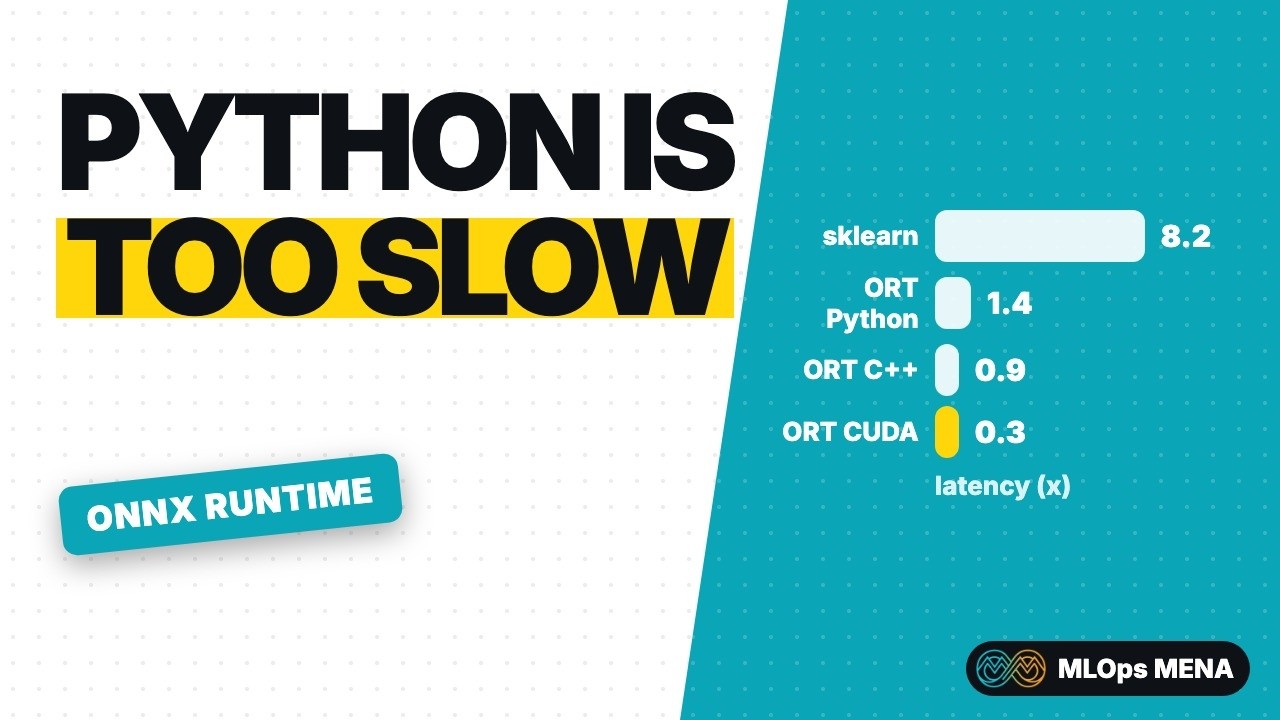 YOUTUBE115 views
ONNX in Production: Speed, When to Use It & Custom Validation | MLOps LLMOps Concepts 06/8
MLOpsMENACommunity22 days ago
 YOUTUBE160 views
The End of ONNX? Native PyTorch Edge AI with ExecuTorch
ManikaAI2471 month ago
 YOUTUBE66 views
ONNX Runtime vs OpenVINO: 3× Faster YOLO on CPU with One Line Changed | Real-Time Vision AI Ep 6
swatahai22 days ago
 YOUTUBE143 views
Why Fewer CPU Threads Made YOLO 2x Faster (ONNX Runtime)
OpenCVUniversity22 days ago
 YOUTUBE61 views
PyTorch → ONNX int8: Smaller, Faster, On-Device (Honest Edge AI Demo)
CodeToAGI1 month ago
 YOUTUBE44 views
ONNX Runtime in Python: Benchmark FP32 vs Dynamic INT8 for a CPU RAG Reranker
ProfessorPyForAIEngineering1 month ago
Capabilities
Key features
Developer Tools
Provides utilities that help programmers build, test, and ship software faster
The honest take
What users love & flag
Distinct themes surfaced across user reviews — each grounded in real review text, ranked by how often it comes up.
Questions
Frequently asked
What is ONNX?
ONNX (Open Neural Network Exchange) is an open standard format that enables machine learning model portability across different frameworks, tools, runtimes, and compilers. It provides a common set of operators and a standardized file format that allows developers to train models in one framework and deploy them in different production environments or on specific hardware without framework lock-in.
Is ONNX free to use?
Yes, ONNX is completely free and open source with no licensing costs. It operates as a community-driven project and is a graduate project of the LF AI & Data Foundation (Linux Foundation), indicating it's a mature and stable standard with open governance.
What problem does ONNX solve?
ONNX solves the model portability problem that occurs when developers build models in one framework but need to deploy them in different production environments or on specific hardware. It eliminates framework lock-in by allowing seamless model transfer between different frameworks, tools, and runtimes while maintaining consistent model behavior across platforms.
How does ONNX maintain model consistency across different platforms?
ONNX defines a common set of operators that serve as building blocks for machine learning models, along with a standardized file format. These common operator definitions ensure that model behavior remains consistent when moving between different platforms, frameworks, and deployment environments.
Can ONNX help with hardware-specific optimizations?
Yes, ONNX facilitates access to hardware-specific optimizations. Runtime libraries designed for particular processors or accelerators can consume ONNX models and apply performance enhancements without requiring changes to the original model, allowing developers to leverage optimized inference engines for their specific hardware.
How does ONNX work as an intermediary format?
ONNX functions as an intermediary representation between training and deployment. Developers export their trained model to ONNX format from their preferred framework, and that ONNX model can then be imported into any ONNX-compatible runtime or inference engine, enabling flexibility in choosing both training frameworks and deployment platforms.
Who controls ONNX and how is it governed?
ONNX operates under open governance with contributions from multiple organizations and individual developers, rather than being controlled by a single company. This vendor-neutral structure ensures the standard evolves to meet diverse industry needs, and the project maintains a contribution guide encouraging broad community participation.
How can I get involved with the ONNX community?
You can engage with the ONNX community through Slack channels, participate in Special Interest Groups (SIGs) focused on specific technical areas, or join Working Groups addressing particular challenges. The organization also hosts meetups and workshops, and maintains a Community Travel Fund to support participation in ONNX events.
Compare ONNX
Compare with another toolMore Like This
