What it is
Overview
NLTK is an open-source Python library for text processing and natural language processing tasks. It's not an AI tool — it's a traditional NLP toolkit built on rule-based methods, statistical models, and linguistic resources. Reviewers most often praise the preprocessing pipeline: tokenization, stemming, lemmatization, and part-of-speech tagging all live in one import. The typical user is a data scientist or NLP researcher prototyping a text analysis workflow or teaching an NLP course. The library ships with over 50 corpora and lexical resources, including WordNet.
At a glance
Usability & Quality overview
Best for
- beginners learning NLP fundamentals
- lightweight text preprocessing
- tokenization and classic NLP experimentation
Watch out for
- performance bottlenecks on larger workloads
- older design compared with spaCy-style alternatives
- mixed reliability reports from some experienced users
Real product, not a wrapperIndependent product
NLTK provides 50+ specialized linguistic corpora and lexical resources (like WordNet and Penn Treebank) that ChatGPT doesn't have direct access to. It offers purpose-built NLP algorithms for tokenization, part-of-speech tagging, parsing, and semantic reasoning that would require extensive custom prompting in a general LLM. This makes it materially better for serious text processing work.
Strong evidenceQuality score
NLTK A broad Python NLP toolkit for learning and text preprocessing, but slower than modern production-focused alternatives.
This score is our editorial judgment, computed automatically from the sources, weights, and dates shown above. It reflects the data we could verify as of November 16, 2026, not a guarantee or statement of fact about NLTK. Third-party ratings and quotes belong to their original platforms and authors. Thin data lowers our confidence label, and we say so instead of guessing. Work on NLTK? Dispute any datapoint and we will review it, publish your response, and correct verified errors.
Plans
Pricing
How free is free?
Genuinely free
Open-source library with no usage limits or paid tiers
What you get for free
- Complete access to 50+ corpora and lexical resources (WordNet, etc.)
- Full NLP toolkit: tokenization, tagging, parsing, semantic reasoning
- Cross-platform support (Windows, macOS, Linux)
- No rate limits, no feature restrictions, no paid upgrades
Community feedback
Aggregated reviews
Ratings and quoted comments below are aggregated from third-party sources and reflect those users' views, not SearchTools.ai's.
What reviewers talk about
themes inside the Sentiment pillar — not score ingredients
58Output Quality16 mentions
“NLTK has plethora of tools to clean and pre-process your text data. I cannot imagine how many hours it would take to sit and manually clean the text data if it wasn't the amazing in-built of NLTK. I would say NLTK has made life of Data Scientists easy. Some of the functionalities like Lemmatization is pretty slow when corpus size is large. So, I have to adjust with stemming. Also, spelling correction functionality doesn't perform that well for SMS language. It would be amazing if the support is ”
“I've been working with Python for a long time, and this toolkit has made things a lot simpler. The features contained in the libraries are simple to use and make working with Python more fluid and painless. I believe it still lacks a number of functionalities that other competitors have included compared to NLTK. They need to upgrade themselves quickly or they might get left behind in the race. It has added more support for NLP and made it more powerful by integrating third-party libraries. The ”
“Do much things to do, with NLTK, word Cloud by book, calculate stuff, creating an autocorrector for dyslexia people... Best things ever ! Good luck !”
“The following are all part of what makes Python my go-to language for almost any problem these days. NumPy and it's sister/parent/child/related libraries SciPy and Matplotlib are indespensible. I can't imagine doing any scientific work without them, even compared to any other language. (They may not replace your other software - I still use R for some purposes, but they'll certainly simplify a lot of stuff). NLTK is also pretty good, if you want to do some natural-language processing. (Be ad”
65Ease of Usethin data · 5 mentions
“I've been working with Python for a long time, and this toolkit has made things a lot simpler. The features contained in the libraries are simple to use and make working with Python more fluid and painless. I believe it still lacks a number of functionalities that other competitors have included compared to NLTK. They need to upgrade themselves quickly or they might get left behind in the race. It has added more support for NLP and made it more powerful by integrating third-party libraries. The ”
“I really like the overall NLTK's API. I often use the whole pre processing pipeline related API's , I also use TextCat for language identification. I also like the pos-tagging API's and the sentiment analysis one . It would be awesome if API's were a little bit faster since by reading some stack overflow answers, I sometimes found users replying to questions presenting some speed benchmarks comparing NLTK's speed with other NLP related libraries and showing it didn't was the fastest one among th”
“The best thing about NLTK is its ease of implementation. Without it, writing algorithms from scratch would take ages, but it helps in quick prototyping. Another great thing about NLTK is its excellent pre-trained models and corpus of data, which make text processing and analysis pretty quick and easy. There is not much to dislike about NLTK, but it has improved a lot over time. I would like it to fine-tune its algorithms more, as some competitors like SpaCy are doing. It only works syntactically”
“As a data scientist NlTK reduces my overhead of using multiple libraries for some preprocessing steps Nothing to dislike, just I had to get familiar with the library as it is the case with any other library to make the use easy and know what to use where. I used it when I was working for my Fiverr client in an image recognition project to preprocess and get sample test cases.”
80Trust derived from dimensions + predator detectionview math
A composite of the quality dimensions weighted by mention volume, then capped by predator / abuse-detection rules.
Reasoning
Watch & learn
Video content
YouTube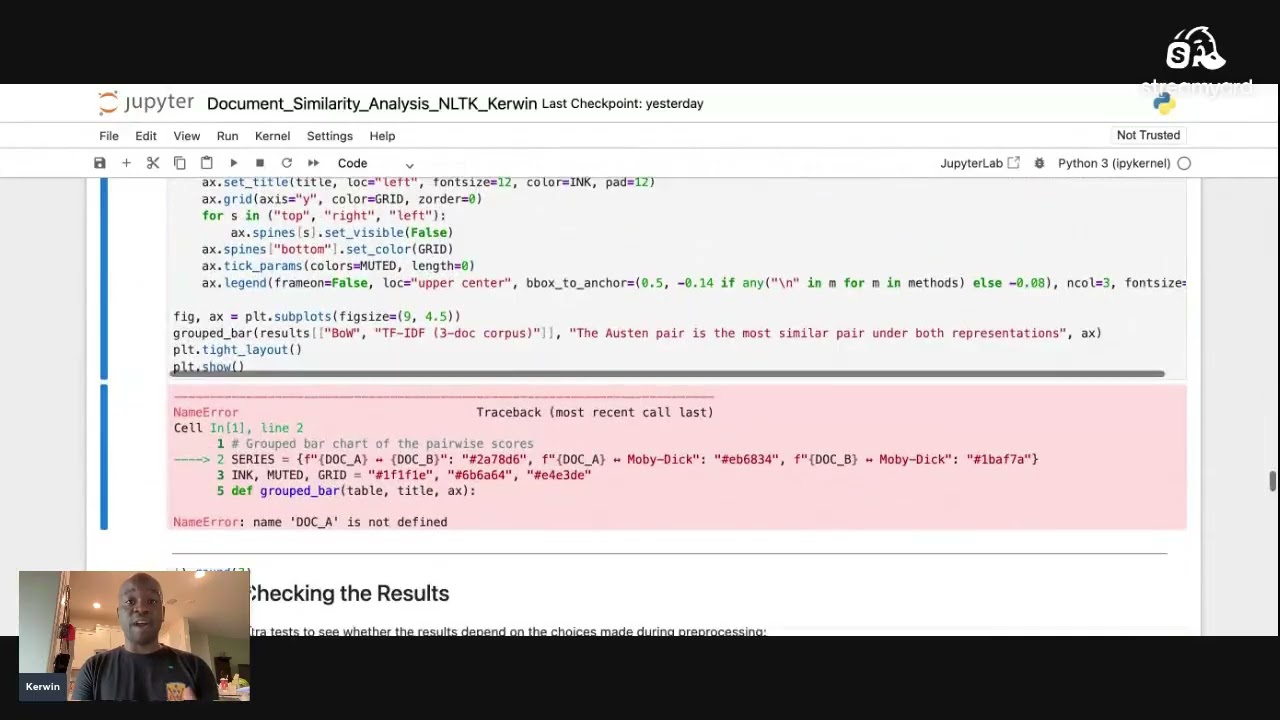 YOUTUBE17 views
Document Similarity Analysis Using NLTK: Bag of Words, TF-IDF & Cosine Similarity
KerwinStewart19 days ago
Capabilities
Key features
Developer Tools
Provides utilities that help programmers build, test, and ship software faster
Research Tool
Gathers, searches, and organizes sources to help you investigate a topic
The honest take
What users love & flag
Distinct themes surfaced across 48 reviews from 1 source — each grounded in real review text, ranked by how often it comes up.
Questions
Frequently asked
What is NLTK?
NLTK (Natural Language Toolkit) is a free, open-source Python library for building natural language processing applications. It provides comprehensive text processing libraries, tokenization, tagging, parsing, and semantic reasoning capabilities, along with direct access to over 50 corpora and lexical resources including WordNet. It's designed for researchers, developers, students, and educators who need to process and analyze text data programmatically.
Is NLTK free to use?
Yes, NLTK is completely free and open source with no licensing fees or usage restrictions. It operates as a community-driven project and is available for Windows, macOS, and Linux platforms. There are no premium tiers or paid features—all functionality is freely accessible.
What can NLTK do for text processing?
NLTK can tokenize text into words and sentences, tag parts of speech to identify grammatical components, and perform named entity recognition to extract people, places, and organizations. It can also parse sentences to generate syntactic tree structures, classify and categorize text using machine learning tools, and perform semantic reasoning. Additionally, it provides wrappers for industrial-strength NLP libraries for more specialized tasks.
What corpora and language resources does NLTK include?
NLTK provides direct access to over 50 corpora and lexical resources, including WordNet. These pre-compiled language datasets save users significant effort in gathering and formatting text data for NLP projects. The included resources support various linguistic analysis tasks without requiring users to source external datasets.
Is NLTK suitable for beginners learning NLP?
Yes, NLTK is specifically designed with a dual focus as both a teaching tool and production platform. It's accompanied by "Natural Language Processing with Python," a book written by NLTK's creators that introduces programming fundamentals alongside computational linguistics concepts. The online version is updated for Python 3 and NLTK 3, making it accessible for students and educators new to the field.
Can I use NLTK for commercial applications?
Yes, NLTK's comprehensive feature set supports both advanced research and commercial applications despite being free and open source. The platform provides industrial-strength capabilities through its core libraries and wrappers for specialized NLP tools. Because it's open source, developers can examine the code, customize functionality for specific use cases, and integrate it into commercial products without licensing restrictions.
What support options are available for NLTK users?
NLTK users have access to an active discussion forum hosted on Google Groups for community support and collaboration. The project maintains comprehensive API documentation covering all features and functions. As an open-source project with an active community, users can also examine the source code on GitHub and contribute improvements.
What makes NLTK different from other NLP tools?
NLTK distinguishes itself through its dual focus as both an educational tool and a production development platform, making computational linguistics accessible to beginners while supporting advanced applications. The inclusion of 50+ corpora and lexical resources provides immediate access to language datasets that would otherwise require significant compilation effort. Its longevity, comprehensive documentation, and strong community support have established it as a foundational tool in the Python NLP ecosystem.
Compare NLTK
Compare with another toolMore Like This