
What it is
Overview
A coding assistant that runs multiple AI agents in parallel — some write code, others review it — then surfaces the full decision trail. Muse Code handles code generation, debugging, test writing, and full-stack app builds through a terminal interface. Early adopters describe the execution speed as the strongest reason they signed up: tasks that take minutes in chat-based tools finish in seconds here. The audience skewing toward the tool is Swift developers and prototype builders who need to ship fast and want to see why the AI made each change.
At a glance
Usability & Quality overview
Best for
- terminal-based AI coding
- multi-agent repo work
- auditable agent workflows
Watch out for
- platform and IDE limitations
- early-stage evidence base
- workflow-first, not clearly model-first differentiation
Real product, not a wrapperIndependent product
Muse Code is a terminal-based coding harness with multi-agent architecture — it automates complex workflows by fanning out tasks to parallel workers and reviewers, all with git-isolated sandboxing and a greppable event log. The harness itself is the product (not just a UI wrapper around an API), which gives it real workflow automation and UX differentiation over typing prompts into ChatGPT directly.
Strong evidenceQuality score
Muse Code A terminal coding agent for complex repo work with auditable multi-agent workflows.
This score is our editorial judgment, computed automatically from the sources, weights, and dates shown above. It reflects the data we could verify as of October 23, 2026, not a guarantee or statement of fact about Muse Code. Third-party ratings and quotes belong to their original platforms and authors. Thin data lowers our confidence label, and we say so instead of guessing. Work on Muse Code? Dispute any datapoint and we will review it, publish your response, and correct verified errors.
Plans
Pricing
How free is free?
No free tier
Paid plans start at $5/mo
Behind the paywall
- Multi-agent coordination for coding workflowsEveryday Usage ($5/mo)
- Parallel workers with reviewer quality checksEveryday Usage ($5/mo)
- Computer-use capabilitiesEveryday Usage ($5/mo)
- Higher usage limits for bigger projectsHigh Usage ($15/mo)
- Intense workflow supportPower Usage ($50/mo)
- Maximum usage capacityMaximum Usage ($200/mo)
Community feedback
Aggregated reviews
Ratings and quoted comments below are aggregated from third-party sources and reflect those users' views, not SearchTools.ai's.
What reviewers talk about
themes inside the Sentiment pillar — not score ingredients
58Output Quality12 mentions
“I’ve tried out nearly all the main coding agents. I continually return to Cursor and Claude Code. However, for the past few weeks I’ve been using Muse Code exclusively. It’s actually pretty phenomenal. Performance is up there with CC. Pricing is similar too. The $200 plan likely gets you slightly less than the 20x max plan by Anthropic, but it’s still a substantial amount. The main difference I found was that the terminal interface was just more intuitive. Honestly, it’s my go-to now. The only d”
“Dont use this model as your main. That rewriting everything will absolutely fk you. Its really fast though, faster than grok so its great for building prototypes”
“In the last 3 weeks I replaced my codex uses with muse code. I mainly use spark 1.3 but yesterday and today I used wonder and wonder full for a few designs and review runs. IMO, muse is incredible with non-UI swift code! And the way it explains its work and designs is so easy to work with. It also seems to have a very solid understanding of modern swift code. My codebase has noncopyable structs and compiles for embedded mode. I don't know if meta trained muse on very modern swift or what but it ”
“it was overwriting files for you? lol BLOCKER, take away its write access and just use it for dirt cheap code reviews and research”
65Value & Pricing10 mentions
“On the $15 dollar plan usage seems really generous I must have used the model for most of the day Sunday and Monday and never hit a 5 hour limit, did consume about 40% of my week max but I have no complaints. Was using multiple sessions at once and only occasionally did it momentarily rate limit me. Probably the best bang for your buck subscription out there in my opinion if you use the contributor model that lets them train off your data.”
“Regarding your observation about Data gathering: Data is extremely valuable to train models. Particularily verifyable coding data. Therefore it's extremely suspicious that their option where you give consent for your data to be harvested is rate limited. As you said, there is no way for you to actually know since you are sending a prompt through an API. Given Zuckerberg's past, I would not be surprised If the "private" option Is there to give users an illusion of choice.”
“I am using muse contributor for 300M token (majority cache hit) for $1 for personal project (NOT ON COMPANY PROJECT).”
“I’ve tried out nearly all the main coding agents. I continually return to Cursor and Claude Code. However, for the past few weeks I’ve been using Muse Code exclusively. It’s actually pretty phenomenal. Performance is up there with CC. Pricing is similar too. The $200 plan likely gets you slightly less than the 20x max plan by Anthropic, but it’s still a substantial amount. The main difference I found was that the terminal interface was just more intuitive. Honestly, it’s my go-to now. The only d”
55Reliabilitythin data · 7 mentions
“On the $15 dollar plan usage seems really generous I must have used the model for most of the day Sunday and Monday and never hit a 5 hour limit, did consume about 40% of my week max but I have no complaints. Was using multiple sessions at once and only occasionally did it momentarily rate limit me. Probably the best bang for your buck subscription out there in my opinion if you use the contributor model that lets them train off your data.”
“I just keep seeing a billing error. model failed: API error 402 [request_id=7659adf8-05c0-4e2a-b68f-c7c2112f5596]: Billing verification failed. Please check your payment method. (billing_error) (after 10 provider attempts) (request id: 99072124-5431-4edd-a0a6-b13a0230e97c) There is no way to go into a console and change/fix billing. So no i haven't 😆”
“Meta has released a native Windows version of Muse Code, its terminal coding agent. Developers no longer need Windows Subsystem for Linux to run it. The update works on both x64 and ARM64 systems. It runs smoothly in PowerShell, stays sandboxed by default, and installs without admin rights. Users can get started with a single command: `irm https://dev.meta.ai/install.ps1 | iex` Muse Code handles complex software tasks across large repositories. It plans changes, writes code, and checks results u”
“I used it for a project today, it did the job really well. Then few hours later I came back to the same project, it created the implementation plan, the spec, the tickets. When i asked it to implement the first ticket it just said OK and crapped out. 😂”
Watch & learn
Video content
YouTube YOUTUBE53.9K views
Meta's Muse Wonder IS OPUS 5.5 LEVEL?! I Don't Think So... (Fully Tested)
intheworldofai11 days ago
 YOUTUBE8.3K views
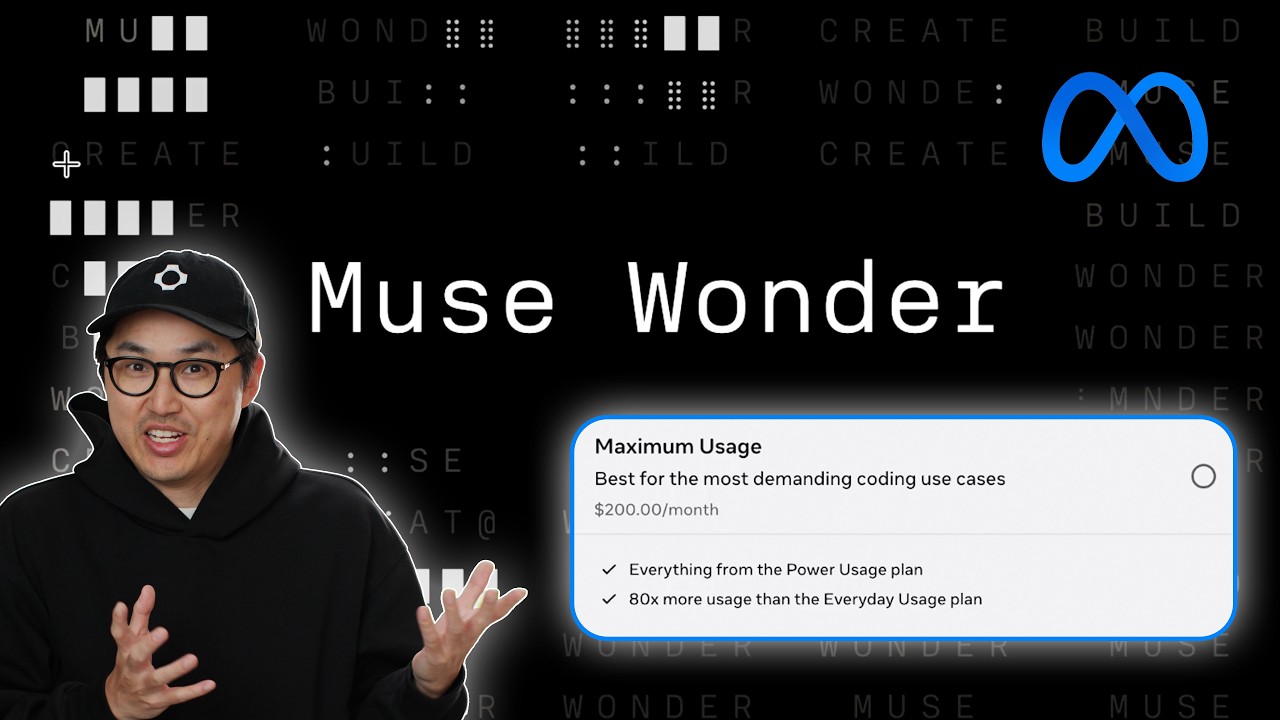
Muse Wonder and Muse Code | How to Generate Images and Videos
fal.ai.official11 days ago
 YOUTUBE6.8K views
Meta Just Dropped Muse Wonder. (I Tested it vs GPT-6 and Claude).
TheAIAutomators10 days ago
 YOUTUBE4K views
NEW Meta Muse Wonder — The ChatGPT & Claude Code AI Killer?
AllThingzReal11 days ago
 YOUTUBE2.8K views
Is Meta's new Muse Wonder model any good?
convex-dev10 days ago
 YOUTUBE405 views
Muse Wonder vs Opus 5.5: 10-Round Showdown (Meta vs Claude)
LifeyGuy8 days ago
Capabilities
Key features
Code Assistant
Helps you write, explain, and fix code directly inside your editor
Developer Tools
Provides utilities that help programmers build, test, and ship software faster
The honest take
What users love & flag
Distinct themes surfaced across user reviews — each grounded in real review text, ranked by how often it comes up.
Questions
Frequently asked
What is Muse Code?
Muse Code is a multi-agent coding assistant developed by Meta that accelerates complex coding workflows through coordinated AI agents. Multiple parallel workers handle tasks simultaneously while reviewers operate in the background to ensure quality, with full transparency and auditability of every action. It's powered by Muse models (Spark 1.3 and 1.2) with 1 million token context windows and includes computer-use capabilities to operate browsers, desktop apps, and mobile applications.
How much does Muse Code cost?
Muse Code offers four subscription tiers: Everyday Usage at $5/month for first projects, High Usage at $15/month with 5x more usage, Power Usage at $50/month with 20x usage and access to the most powerful models, and Maximum Usage at $200/month for the most demanding use cases with 80x usage. API pricing is also available, with the muse-spark-1.3-contributor version charging $0.10 per million input tokens and $0.20 for output tokens.
What makes Muse Code different from other coding assistants?
Muse Code distinguishes itself through its multi-agent architecture that runs by default rather than as an optional feature, with parallel workers executing tasks while reviewers maintain quality standards. The system provides full auditability and transparency, allowing developers to review generated code and understand every AI decision, which is typically absent in other coding assistants. It's co-trained with Muse models for tight integration, resulting in better tool use, fewer retries, and higher-quality output compared to generic wrappers.
What are the computer-use capabilities in Muse Code?
Muse Code includes advanced computer-use capabilities that enable AI agents to see and operate browsers, desktop applications, and mobile apps to complete everyday tasks. This allows the system to automate operations across different platforms and interfaces as part of the coding workflow. The tool includes documentation and cookbooks specifically for leveraging these computer-use features.
How does the multi-agent coordination work in Muse Code?
When a developer inputs a coding request through the command-line interface, multiple AI agents coordinate on the task with parallel workers executing simultaneously while reviewers operate in the background. The system supports agent fan-out for parallel work in isolated worktrees, allowing faster code shipping. Every action is transparent and traceable, and the tool includes cookbooks for multi-agent orchestration to help developers leverage this architecture effectively.
How do I install Muse Code?
Installation is straightforward with a single command via curl for both MacOS and Windows platforms. The tool operates through a command-line interface where developers can input coding requests and interact with the multi-agent system.
Can Muse Code access the internet during coding tasks?
Yes, Muse Code includes web search integration and search grounding capabilities that provide real-time web access during coding workflows. This allows the AI agents to access current information and resources while working on your code, with documentation available on how to leverage search grounding effectively.
What models power Muse Code?
Muse Code is powered by Muse models, specifically Muse Spark 1.3 and 1.2, which feature context windows of 1 million tokens. The system is co-trained for tight integration with these models, and higher-tier plans provide access to more powerful Muse models including Muse Wonder for the most demanding coding workflows.
Is the code generation process in Muse Code auditable?
Yes, Muse Code provides full auditability and transparency for every action the system takes. Developers can review all generated code, understand AI decisions, and trace how their code is being generated and modified, giving complete visibility into the development process that is typically absent in other coding assistants.
Compare Muse Code
Compare with another toolMore Like This
