
Low confidence — this score is based on limited public data (mostly aggregate ratings, with little independent discussion or review detail), so it may not reflect real-world quality.
What it is
Overview
Milvus is a vector database — infrastructure for storing and searching embeddings at scale. Not an AI model itself, but the layer that sits between your embedding model and your application when you need to find similar vectors fast. ML engineers and backend developers building retrieval-augmented generation systems or semantic search tools end up here when local storage stops scaling. Open-source, with a managed cloud option. The architecture scales from a pip install on a laptop to distributed clusters handling billions of vectors.
At a glance
Usability & Quality overview
Best for
- self-hosted vector search
- high-throughput ANN workloads
- teams comfortable with Kubernetes and distributed systems
Watch out for
- Kubernetes and multi-node operational overhead
- memory-sensitive workloads
- disk-offload expectations on very large collections
Real product, not a wrapperIndependent product
Milvus is purpose-built vector database infrastructure that handles billion-scale similarity search with specialized indexing algorithms and distributed architecture. This is not something you can replicate by prompting ChatGPT — it provides the underlying data layer that AI applications query. Developers cite production integrations with S3, Kubernetes, and Langchain, plus the ability to run locally or scale to cloud clusters.
Strong evidenceQuality score
Milvus High-speed vector search for self-hosted GenAI apps, but setup is complex.
This score is our editorial judgment, computed automatically from the sources, weights, and dates shown above. It reflects the data we could verify as of November 16, 2026, not a guarantee or statement of fact about Milvus. Third-party ratings and quotes belong to their original platforms and authors. Thin data lowers our confidence label, and we say so instead of guessing. Work on Milvus? Dispute any datapoint and we will review it, publish your response, and correct verified errors.
PricingFree
Individual plan details haven't been verified yet — they'll appear here on the next data refresh.
Community feedback
Aggregated reviews
Ratings and quoted comments below are aggregated from third-party sources and reflect those users' views, not SearchTools.ai's.
What reviewers talk about
themes inside the Sentiment pillar — not score ingredients
58Output Qualitythin data · 8 mentions
“Hey guys, wanted to post my early beta version of this system i'm working on. The goal of this is to help people find old bits, shows, and fools'-coverages from the back catalog of Redbar. This uses a pipeline of faster-whisper -> Milvus Vector -> llama3.3 local -> gpt-5.2 to generate summaries, topic tagging and fool tagging, segmentation of bits and segments of each show, classifies them all, lists the timestamp ranges of each of them, allows you to search for fools or bits or keywords, et”
“Any recommendation? From google Weaviate ————— Strengths: Focus on semantic search: Weaviate excels at understanding the meaning behind search queries, going beyond simple keyword matching. It uses GraphQL for querying, making it flexible and powerful. Built-in modules: Offers modules for text, image, and other data types, simplifying integration. Strong community: Active and growing community with good documentation and support. Weaknesses: Performance: Can be slower than Milvus for very large ”
“Jiang from Milvus here. Looks like Google AI overview give a pretty good summary :D Overall I agree Milvus is a relatively sophisticated vector database as it’s designed for production and scalability. The community tries to make it a bit more accessible by introducing Milvus Lite, which is simpler and good for prototyping and small machines like laptop. Hopefully that can flatten the learning curve a bit. Also maybe I’m opinionated but I do want to say something regarding this point: "Pri”
“I picked Milvus for my research project because it (a) could be run locally, (b) has a very modular and scalable architecture, (c) cloud friendly dependencies ex S3, K8s, etc (d) Langchain support, which was important to me at the time (e) multiple index types & indexing options. I didn’t spend much time with Pinecone since I didn’t want to pay for an API. Moreover I didn’t take a close look at others once I confirmed Milvus met my criteria. After spending about a year with it here are some ”
53Ease of Usethin data · 6 mentions
“Jiang from Milvus here. Looks like Google AI overview give a pretty good summary :D Overall I agree Milvus is a relatively sophisticated vector database as it’s designed for production and scalability. The community tries to make it a bit more accessible by introducing Milvus Lite, which is simpler and good for prototyping and small machines like laptop. Hopefully that can flatten the learning curve a bit. Also maybe I’m opinionated but I do want to say something regarding this point: "Pri”
“I need to host a milvus database preferably on GCP and a standalone database. We are a small team and need to individually access the database remotely. I have tried setting up a standalone milvus database on Google Kubernetes Engine with LoadBalancer but I am never able to connect to the external IP. Please can someone assist me with this or give me a guide to follow, I am still very new to Milvus.”
“I picked Milvus for my research project because it (a) could be run locally, (b) has a very modular and scalable architecture, (c) cloud friendly dependencies ex S3, K8s, etc (d) Langchain support, which was important to me at the time (e) multiple index types & indexing options. I didn’t spend much time with Pinecone since I didn’t want to pay for an API. Moreover I didn’t take a close look at others once I confirmed Milvus met my criteria. After spending about a year with it here are some ”
“What happens if I use a model with a different dimension? Need a new collection every time? 🧐”
Watch & learn
Video content
YouTube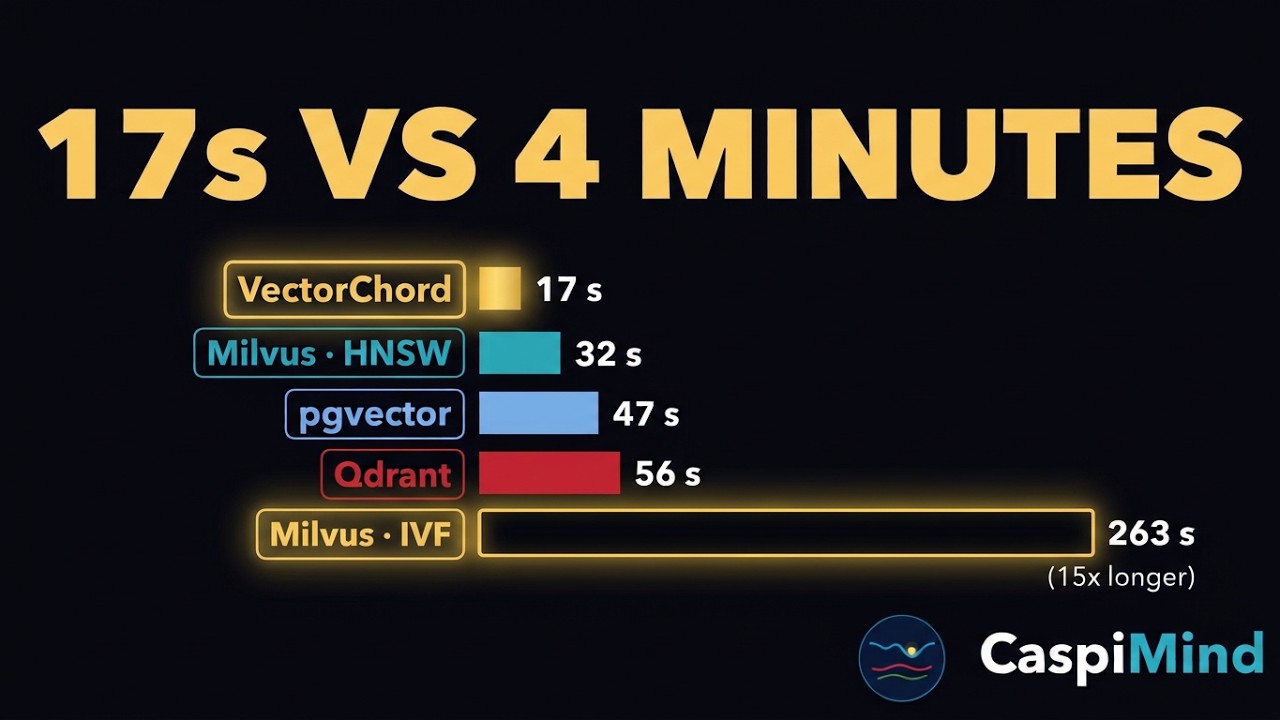 YOUTUBE4K views
Qdrant vs Milvus vs pgvector vs VectorChord vs FAISS: We Measured Them
caspimind28 days ago
 YOUTUBE109 views
Ultimate Vector Database: Pinecone vs Milvus vs Weaviate vs Qdrant
NikhilTech1 month ago
 YOUTUBE73 views
From Retrieval to Action: Building Production Agents on AWS | Milvus Meetup SF
MilvusVectorDatabase28 days ago
 YOUTUBE61 views
AI 向量數據庫天花板|Milvus 是什麼?架構是怎麼樣的,從單機到分佈式講透Standalone & distributed architecture#Milvus #向量數據庫 #AI 基礎技術
xiaobaidebug7 days ago
 YOUTUBE52 views
One RAG App. Four Database Options. Let’s Choose. | Week 4 Day 3
BuildLifeandAI17 days ago
Capabilities
Key features
Developer Tools
Provides utilities that help programmers build, test, and ship software faster
The honest take
What users love & flag
Distinct themes surfaced across user reviews — each grounded in real review text, ranked by how often it comes up.
Questions
Frequently asked
What is Milvus?
Milvus is an open-source vector database designed for performing high-speed similarity searches on massive datasets of high-dimensional vectors in GenAI applications. It enables data scientists and ML engineers to efficiently store and query vector embeddings at scale, from prototyping with a simple pip install to enterprise deployments handling billions of vectors.
Is Milvus free to use?
Yes, Milvus is open-source and free to use in all self-hosted deployment options including Milvus Lite, Standalone, and Distributed versions. The only paid option is Zilliz Cloud, which offers a fully managed version with serverless and dedicated cluster options.
What deployment options does Milvus offer?
Milvus offers four deployment options: Milvus Lite (pip-installable library for notebooks and prototyping), Milvus Standalone (single-machine production for up to millions of vectors), Milvus Distributed (horizontally scalable enterprise solution for billions of vectors), and Zilliz Cloud (fully managed SaaS or BYOC option). This allows you to start small and scale as your needs grow.
What AI frameworks does Milvus integrate with?
Milvus integrates directly with popular AI development frameworks including LangChain, LlamaIndex, OpenAI, Hugging Face, DSPy, Haystack, Ragas, and MemGPT. These integrations make it straightforward to build RAG systems and other GenAI applications using your existing development stack.
What types of search capabilities does Milvus support?
Milvus supports vector similarity search with various distance metrics, metadata filtering, hybrid search that combines vector similarity with traditional queries, multi-vector search, and multimodal search across text, image, and other data types. It also features what it calls Global Index for fast retrieval regardless of dataset scale.
How does Milvus handle scaling from prototype to production?
Milvus emphasizes reusable code that allows developers to write once and deploy to production with one line of code. You can start prototyping with Milvus Lite on your laptop, then move to Standalone for single-machine production, and finally scale to Milvus Distributed for enterprise workloads handling billions of vectors without rewriting your application.
What are common use cases for Milvus?
Common use cases include building retrieval-augmented generation (RAG) systems, image similarity search engines, recommendation systems, multimodal search applications, hybrid search solutions, and graph RAG implementations. Organizations like Salesforce, Walmart, Reddit, IBM, NVIDIA, and Roblox use Milvus for production workloads.
How many vectors can Milvus handle?
Milvus can scale from millions to tens of billions of vectors depending on the deployment option. Milvus Standalone is suitable for datasets with up to millions of vectors, while Milvus Distributed can scale elastically to handle tens of billions of vectors while maintaining fast retrieval speeds.
Compare Milvus
Compare with another toolMore Like This
