
What it is
Overview
Kubeflow is an open-source orchestration system for machine learning workloads that runs on Kubernetes clusters. The project provides modular components for training models, building pipelines, and running Jupyter notebooks across distributed infrastructure. Early reviewers are ML engineers already running Kubernetes in production and MLOps teams managing multi-cloud deployments. This is not an AI tool — it's infrastructure software for teams deploying machine learning at scale.
At a glance
Usability & Quality overview
Best for
- Kubernetes-native ML teams
- end-to-end ML workflow orchestration
- flexible multi-component MLOps stacks
Watch out for
- Steep installation and configuration burden
- Documentation that assumes specific cloud environments
- Need for strong Kubernetes expertise
Real product, not a wrapperIndependent product
Kubeflow is infrastructure for running ML workloads on Kubernetes at scale — it provides orchestration, pipeline automation, and integrations with cloud providers (AWS, GCP) and ML frameworks (TensorFlow, PyTorch, XGBoost) that ChatGPT cannot replicate. This is not a prompt wrapper; it's a platform for teams deploying production ML systems.
Strong evidenceQuality score
Kubeflow Kubernetes-native ML workflow orchestration with modular end-to-end pipelines, but setup is complex.
This score is our editorial judgment, computed automatically from the sources, weights, and dates shown above. It reflects the data we could verify as of November 16, 2026, not a guarantee or statement of fact about Kubeflow. Third-party ratings and quotes belong to their original platforms and authors. Thin data lowers our confidence label, and we say so instead of guessing. Work on Kubeflow? Dispute any datapoint and we will review it, publish your response, and correct verified errors.
PricingFree
Individual plan details haven't been verified yet — they'll appear here on the next data refresh.
Community feedback
Aggregated reviews
Ratings and quoted comments below are aggregated from third-party sources and reflect those users' views, not SearchTools.ai's.
What reviewers talk about
themes inside the Sentiment pillar — not score ingredients
58Output Quality21 mentions
“Are you talking about SageMaker autoscaling? You should look at Kubeflow. It gives you a lot. Here are some good articles and examples of different frameworks using Kubeflow. If you are interested in model serving and how Kubeflow can help, this is a good article: https://www.kubeflow.org/docs/external-add-ons/serving/mlrun/ Here's another one showing training XGBoost: https://www.kubeflow.org/docs/components/training/xgboost/”
“Never used MLFlow, but our entire org HATES Kubeflow”
“Kubeflow is whatever. It makes some things easier, but it’s also overengineered to hell when you’re not at scale. If your intent is to learn ML deployment, you’re barking up the wrong tree: most runtime inferencing shares a lot of properties with stateless web services, but resource requirements are different, monitoring is more complex (ie model drift), and autoscaling is harder. Batch is another sorta mostly same bust subtly different sorta story. Fuck ML. Learn to deploy and maintain trad”
“They solve different problems in the ML lifecycle, which is why they end up together in mature setups. MLflow is a tracking and experiment management tool. It logs your runs, parameters, metrics, and artifacts so you can compare experiments, reproduce results, and serve models. Think of it as the bookkeeping layer. It's lightweight, you can run it locally or on a small server, and it integrates with basically everything. Kubeflow is an orchestration platform for running ML workloads on Kuber”
38Ease of Use17 mentions
“I like the portability of it, which makes it easier to work with any Kubernetes clusters whether it's on a single computer or in the cloud. It was difficult to set up initially; we had to keep dedicated team members to set it up. It is very helpful when it comes to simplifying ML workflows. After implementing Kuberflow, the efficiency of the workflow has increased.”
“I want to learn Kubeflow and have found a lot of resources online but the main problem is I have not gotten started with any one of them, I am stuck in just setting up kubeflow in my system. I have a old i5, 8gb ram laptop that I ssh into for kubeflow because I need my daily laptop for work and dont have enough space in it. Since the system is low spec I chose K3s with minimal selective few kubeflow tooling. But still I am not able to set it up properly, most of my pods are running but some are ”
“Why did you decide to learn kubeflow? It requires basic k8s administration skill to be able to resolve misc issues. There are great courses on kubernetes on slurm. I would recommend start with those. But first it might be valuable to understand what is your end goal. Kubeflow is not the be all and end all. For simple projects it could be too complicated.”
“Kubeflow is whatever. It makes some things easier, but it’s also overengineered to hell when you’re not at scale. If your intent is to learn ML deployment, you’re barking up the wrong tree: most runtime inferencing shares a lot of properties with stateless web services, but resource requirements are different, monitoring is more complex (ie model drift), and autoscaling is harder. Batch is another sorta mostly same bust subtly different sorta story. Fuck ML. Learn to deploy and maintain trad”
77Trust derived from dimensions + predator detectionview math
A composite of the quality dimensions weighted by mention volume, then capped by predator / abuse-detection rules.
Reasoning
Watch & learn
Video content
YouTube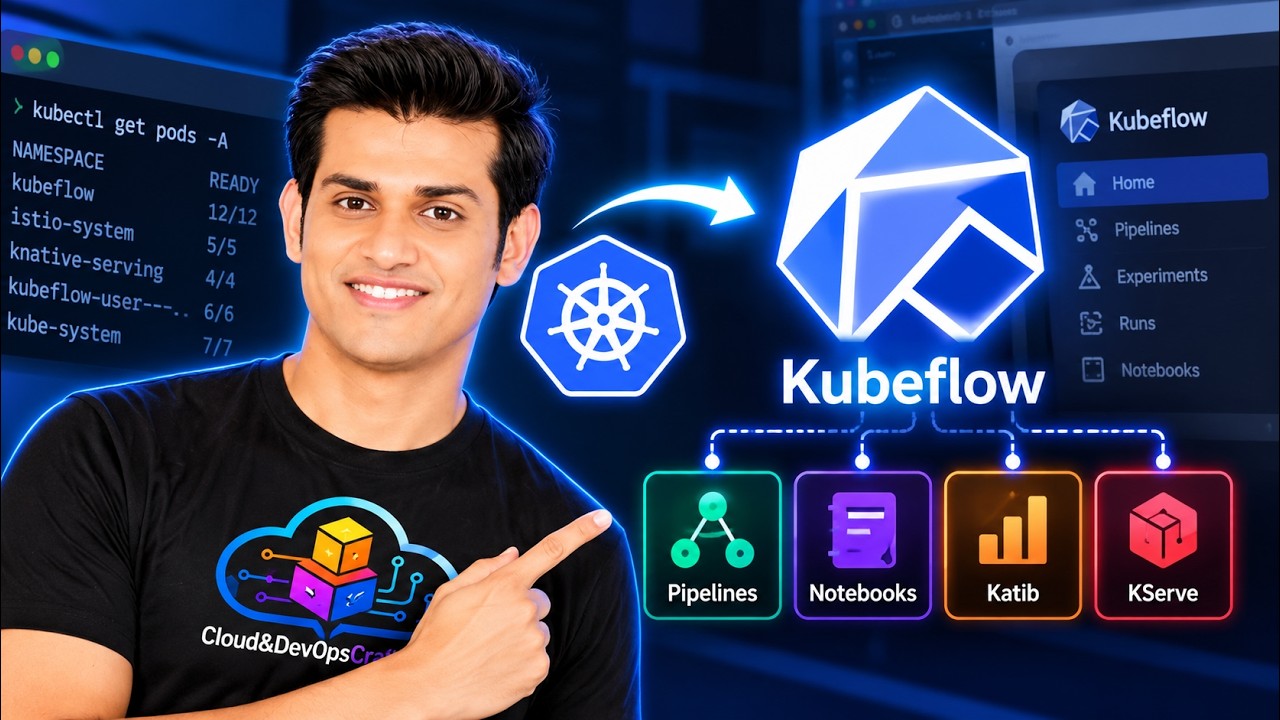 YOUTUBE337 views
Install Kubeflow on Kubernetes with Kind | Local MLOps Setup Tutorial
CloudDevOpsCrafted26 days ago
 YOUTUBE94 views
OpenShift AI MLOps Part 2 | Build an End-to-End CI Pipeline with Kubeflow
skteam6926 days ago
 YOUTUBE234 views
Kubeflow Graduation: Powering the Next Era of... Ron K., Andrey V., Vara B., Ekin K. & Manabu M.
cncf8 days ago
Capabilities
Key features
Developer Tools
Provides utilities that help programmers build, test, and ship software faster
Workflow Management
Automates multi-step processes and routes tasks across your tools and team
The honest take
What users love & flag
Distinct themes surfaced across 21 reviews from 1 source — each grounded in real review text, ranked by how often it comes up.
Questions
Frequently asked
What is Kubeflow?
Kubeflow is an open-source, Kubernetes-native platform for deploying and managing AI and machine learning workloads at scale. It provides modular tools for the full ML lifecycle including model training, hyperparameter tuning, pipelines, and notebooks, and runs across any cloud provider or on-premises infrastructure without requiring code changes.
Is Kubeflow free to use?
Yes, Kubeflow is completely free and open-source software with no licensing fees. It's a Cloud Native Computing Foundation project with contributions from over 3,000 developers and is used by organizations including AWS, Oracle, and Red Hat.
Do I need to be a Kubernetes expert to use Kubeflow?
No, Kubeflow is designed to allow teams to run ML workloads at any scale without requiring deep Kubernetes expertise. While it's built on Kubernetes, the platform emphasizes simplicity for data scientists and ML engineers, though it maintains flexibility for advanced users who want to customize configurations.
What machine learning frameworks does Kubeflow support for training?
Kubeflow Trainer supports distributed AI training with multiple frameworks including PyTorch, MLX, HuggingFace, DeepSpeed, Megatron-LM, JAX, and XGBoost. This enables scalable LLM fine-tuning and hyperparameter optimization across different training frameworks.
Can I use individual Kubeflow components without adopting the entire platform?
Yes, Kubeflow is designed with composability as a core principle, offering modular subprojects that can be used independently or together. Organizations can adopt specific tools like Kubeflow Notebooks, Katib for hyperparameter tuning, or Pipelines based on their specific needs rather than implementing the entire platform at once.
What is Kubeflow Katib used for?
Kubeflow Katib automates machine learning tasks through hyperparameter tuning, early stopping, and neural architecture search. It helps optimize model performance by systematically exploring different hyperparameter configurations and architectures without manual experimentation.
How does Kubeflow handle model versioning and management?
Kubeflow Hub (formerly called Model Registry) indexes and manages model versions and ML artifact metadata throughout the production lifecycle. It bridges the gap between experimentation and production by providing centralized tracking of models and their associated artifacts.
Can Kubeflow run on multiple cloud providers or just one?
Kubeflow provides true portability across computing environments, running on local laptops, on-premises infrastructure, or any cloud environment without requiring code changes. This makes it particularly suitable for organizations with multi-cloud strategies or hybrid infrastructure requirements.
What is Kubeflow Pipelines used for?
Kubeflow Pipelines (KFP) enables teams to build and deploy portable, scalable machine learning workflows on Kubernetes. It provides workflow automation capabilities for orchestrating complex ML processes from data preparation through model training and deployment.
Does Kubeflow support Apache Spark workloads?
Yes, Kubeflow includes a Spark Operator that makes running Apache Spark applications on Kubernetes as straightforward as running other Kubernetes workloads. This allows data processing and ML workflows that rely on Spark to integrate seamlessly with other Kubeflow components.
Compare Kubeflow
Compare with another toolMore Like This
