
Low confidence — this score is based on limited public data (mostly aggregate ratings, with little independent discussion or review detail), so it may not reflect real-world quality.
What it is
Overview
KServe is an open-source deployment layer for AI models on Kubernetes. It handles the infrastructure work of serving generative and predictive models at scale — autoscaling based on load, splitting traffic across model versions, and exposing endpoints that match the OpenAI API format. The recurring user in the 6,000 monthly visits is the MLOps engineer or infrastructure lead managing inference workloads for a team that already runs Kubernetes.
At a glance
Usability & Quality overview
Best for
- Kubernetes teams serving ML models
- Production inference with autoscaling
- Platform engineering teams already invested in Kubernetes
Watch out for
- Cold-start latency from scale-to-zero
- Steep setup and platform complexity
- May be a poor fit for some LLM-serving workflows
Real product, not a wrapperIndependent product
KServe solves a production infrastructure problem that general-purpose LLMs like ChatGPT can't address: deploying AI models on Kubernetes with autoscaling, canary rollouts, and traffic splitting. It integrates deeply with the Kubernetes ecosystem (KEDA, Gateway API) and automates multi-step workflows like model versioning and rollback—capabilities that require specialized tooling, not just prompt engineering.
Strong evidenceQuality score
KServe Kubernetes-native model serving for autoscaling AI workloads, but cold starts can be slow.
This score is our editorial judgment, computed automatically from the sources, weights, and dates shown above. It reflects the data we could verify as of November 16, 2026, not a guarantee or statement of fact about KServe. Third-party ratings and quotes belong to their original platforms and authors. Thin data lowers our confidence label, and we say so instead of guessing. Work on KServe? Dispute any datapoint and we will review it, publish your response, and correct verified errors.
PricingFree
Individual plan details haven't been verified yet — they'll appear here on the next data refresh.
Watch & learn
Video content
YouTube YOUTUBE457 views
KServe Explained: The Easiest Way to Deploy ML Models on Kubernetes
ghanatheyneelesh29 days ago
 YOUTUBE34 views
Confidential AI inference on Red Hat OpenShift AI
openshiftsandboxedcontaine168614 days ago
 YOUTUBE18 views
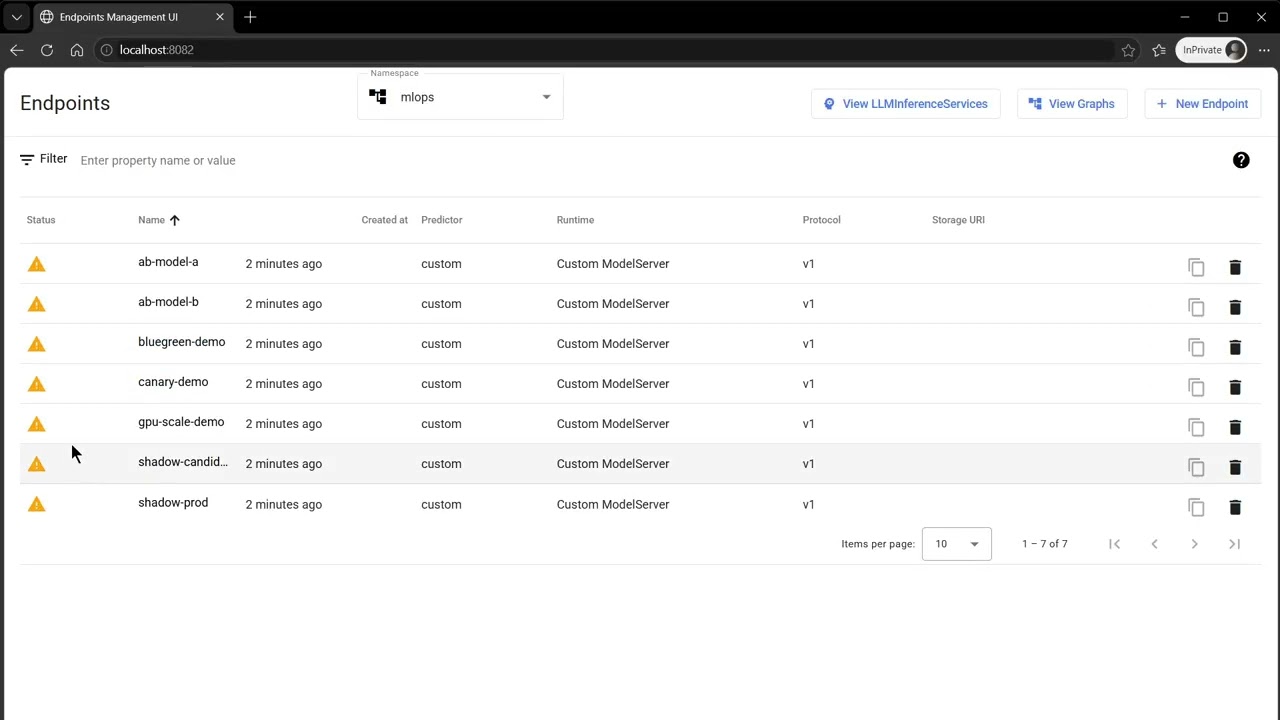
[LLMOps] 쿠버네티스 KServe 5대 핵심 AI 모델 배포 전략 실전 시연! (카나리, 블루그린, GPU 오토스케일링, 트래픽 미러링, A/B 테스팅)
jaxman-ai-pair-programmer16 days ago
Capabilities
Key features
Developer Tools
Provides utilities that help programmers build, test, and ship software faster
DevOps Assistant
Automates deployment, monitoring, and infrastructure tasks across your software delivery pipeline
The honest take
What users love & flag
Distinct themes surfaced across user reviews — each grounded in real review text, ranked by how often it comes up.
Questions
Frequently asked
What is KServe?
KServe is an open-source platform for deploying and managing AI models on Kubernetes at scale. It supports both generative AI models like large language models and traditional predictive ML models, providing standardized deployment through simple YAML configurations with built-in autoscaling, canary rollouts, and multi-framework support.
Is KServe free to use?
Yes, KServe is completely free and open-source. It recently joined the Cloud Native Computing Foundation as an incubating project and can be installed on any Kubernetes cluster by applying a YAML manifest.
What ML frameworks does KServe support?
KServe supports multiple ML frameworks including HuggingFace, TensorFlow, PyTorch, scikit-learn, XGBoost, and ONNX. This multi-framework support eliminates the need to learn framework-specific deployment tools, providing a standardized API across all supported frameworks.
Does KServe support OpenAI-compatible APIs?
Yes, KServe provides drop-in OpenAI protocol compatibility for generative AI workloads. This allows existing applications built for OpenAI's API to integrate with KServe-deployed models without requiring any code changes.
How does KServe handle GPU cost optimization?
KServe includes scale-to-zero capabilities that automatically shut down unused model servers to reduce infrastructure costs on expensive GPU resources. It also features GPU memory optimization, KV cache offloading to CPU or disk for longer sequences, and model caching to reduce load times.
Can KServe do canary deployments and A/B testing?
Yes, KServe supports canary rollouts and A/B testing through its InferenceGraph resource. This enables advanced deployment patterns including gradual model updates with traffic splitting, multi-model pipelines, and ensemble deployments for safer production rollouts.
What monitoring capabilities does KServe provide?
KServe offers comprehensive monitoring including payload logging, outlier detection, adversarial detection, and drift detection through Prometheus metrics integration. For predictive models, it also provides built-in model explainability through feature attribution.
What backends does KServe use for LLM serving?
For generative AI workloads, KServe integrates optimized backends like vLLM and llm-d for high-performance LLM serving. These backends provide GPU memory optimization, KV cache management, and model caching specifically tuned for large language model inference.
Who uses KServe in production?
KServe is used in production by major organizations including Bloomberg, IBM, Red Hat, NVIDIA, AMD, Kubeflow, Cloudera, Canonical, and Cisco across various industries. This demonstrates its reliability and scalability for enterprise-grade AI model deployment.
How does KServe simplify model deployment?
KServe uses a Kubernetes Custom Resource Definition called InferenceService that encapsulates deployment complexity into simple YAML configurations. Users only need to specify their model format, provide a storage URI pointing to model files, and define resource requirements like CPU, memory, and GPU allocation.
Compare KServe
Compare with another toolMore Like This
