
Kiro
What it is
Overview
A code assistant that breaks development requests into structured specifications before writing code. Instead of direct prompt-to-code generation, it creates requirements documents that teams can review, then deploys parallel AI agents to implement against the approved specs. Built by AWS with enterprise development workflows in mind. The 3.8 million monthly visits skew toward development teams and project managers who need collaborative oversight before code generation.
At a glance
Usability & Quality overview
Best for
- medium-to-large projects requiring structured spec-driven development
- developers who want educational workflow guidance
- enterprise teams prioritizing spec-first planning
Watch out for
- Terminal execution frequently hangs and requires manual commands
- Free tier (50 requests/month) exhausted in a single 2-hour session
- Confusing pricing; hooks cost too much for small tasks
Real product, not a wrapperIndependent product
Kiro offers genuine workflow automation through its spec-driven development approach and specialized fine-tuning for enterprise development. Built by AWS, it provides integrated project management and requirements collaboration that goes beyond simple AI code completion tools.
Strong evidenceQuality score
Kiro A bold spec-driven AI IDE that structures coding education and parallel agent implementation well for medium-to-large projects, but expensive at scale with terminal automation quirks.
This score is our editorial judgment, computed automatically from the sources, weights, and dates shown above. It reflects the data we could verify as of July 20, 2026, not a guarantee or statement of fact about Kiro. Third-party ratings and quotes belong to their original platforms and authors. Thin data lowers our confidence label, and we say so instead of guessing. Work on Kiro? Dispute any datapoint and we will review it, publish your response, and correct verified errors.
Plans
Pricing
How free is free?
Free with limits
50 credits on free tier; Pro starts at $20/mo for 1,000 credits
What you get for free
- 50 credits included
- Access to open weight models and Claude Sonnet 4.5
Behind the paywall
- Higher credit allowance (1,000+ credits)Pro ($20/mo)
- Access to premium modelsPro ($20/mo)
- Add-on credits ($0.04/credit)Pro ($20/mo)
Cost to actually use
Based on 25 classified review complaints about rate limits, credits, and billing.
Community feedback
Aggregated reviews
Ratings and quoted comments below are aggregated from third-party sources and reflect those users' views, not SearchTools.ai's.
What reviewers talk about
themes inside the Sentiment pillar — not score ingredients
60Output Quality44 mentions
“Kiro is the most production-ready process I've seen so far. Kiro's innovation is not in the IDE or with a better LLM, it's the built in project management portion that is "spec-first ". So, you start out telling Kiro what you want to build. I want to build this amazing app that does all of this stuff (blah blah blah)....and I want it to be usable by people with accessibility needs. It then breaks this into a Requirements document that you collaborate on. It takes your prompt ramblings about what”
“If you ship today’s AI agent tech straight into production with real permissions and no guardrails, you’re basically deploying an eager intern with root access and zero impulse control. Agents hallucinate, they misinterpret goals, they take irreversible actions, and they fail in weird edge cases you won’t catch until it’s 3am and prod is on fire. If your plan is “we’ll just monitor it,” congrats, you reinvented incident response as a product feature.”
“Amazon's Kiro agent inherited elevated permissions, bypassed two-person approval, and deleted a production environment — 13-hour AWS outage. Amazon called it "a coincidence that AI tools were involved." That's one of ten. Replit's agent fabricated 4,000 fake records then deleted the real database. Cursor's agent deleted 70 files after the developer typed "DO NOT RUN ANYTHING." Claude Cowork wiped 15 years of family photos. Every incident sourced — Financial Times, GitHub issues, company statemen”
“The confirmation-bias, plagarism, hallucination machine destroying production environments? It could never ...”
33Value & Pricing15 mentions
“Finally! I use an average of 4-5k credits a month and having this tier is a blessing!!”
“Trying to pay for this service is a nightmare. I have tried multiple valid, working international cards that work perfectly everywhere else. Kiro's payment gateway constantly rejects them with zero explanation. If a company can't even fix their billing system to take customers' money, I can't trust them with my development workflow. Maybe you should ask your own AI to fix this billing bug. Terrible onboarding experience. Fix your payment processor.”
“Paid $20.41 for Kiro Pro+ on March 17 for a two-week Pro+ subscription. A few days later my account got hit with a suspension notice out of nowhere — "User ID temporarily suspended as a security precaution," no warning, no reason given. I'd been a paying customer for less than a week at that point. Opened an AWS support case on March 21 (#177410938500826). They asked for info on the 24th, I sent everything back the same day. Then nothing. Radio silence for weeks. On April 1, while I was still ”
“i upgrade my kiro plan month of 23th affter 7 to 8 days my kiro plan has been canceled even one month is not complete no any refund and also customar support is not good not reply my emails ”
30Reliability28 mentions
“This is the first big company to have an agenic IDE... It's a great start!.. plus being built on vscode you have the ability to still use claude code terminal and cline code/open router. It's nice to have an agentic IDE that's not run by a small company. I am sure we'll still have drama, but it won't be like windsurf”
“If you ship today’s AI agent tech straight into production with real permissions and no guardrails, you’re basically deploying an eager intern with root access and zero impulse control. Agents hallucinate, they misinterpret goals, they take irreversible actions, and they fail in weird edge cases you won’t catch until it’s 3am and prod is on fire. If your plan is “we’ll just monitor it,” congrats, you reinvented incident response as a product feature.”
“Amazon's Kiro agent inherited elevated permissions, bypassed two-person approval, and deleted a production environment — 13-hour AWS outage. Amazon called it "a coincidence that AI tools were involved." That's one of ten. Replit's agent fabricated 4,000 fake records then deleted the real database. Cursor's agent deleted 70 files after the developer typed "DO NOT RUN ANYTHING." Claude Cowork wiped 15 years of family photos. Every incident sourced — Financial Times, GitHub issues, company statemen”
“An AI agent inheriting elevated permissions and bypassing two-person approval is exactly the failure mode everyone warned about. The blast radius of a misconfigured agent is orders of magnitude larger than a misconfigured human because it moves faster and doesn't hesitate.”
57Ease of Use15 mentions
“Kiro is the most production-ready process I've seen so far. Kiro's innovation is not in the IDE or with a better LLM, it's the built in project management portion that is "spec-first ". So, you start out telling Kiro what you want to build. I want to build this amazing app that does all of this stuff (blah blah blah)....and I want it to be usable by people with accessibility needs. It then breaks this into a Requirements document that you collaborate on. It takes your prompt ramblings about what”
“Trying to pay for this service is a nightmare. I have tried multiple valid, working international cards that work perfectly everywhere else. Kiro's payment gateway constantly rejects them with zero explanation. If a company can't even fix their billing system to take customers' money, I can't trust them with my development workflow. Maybe you should ask your own AI to fix this billing bug. Terrible onboarding experience. Fix your payment processor.”
“I first installed Kiro shortly after it released and I used it for about a month within the free trial. Recently I got an email saying I got free 1k credits to spend in Kiro, so after a few months I once again opened Kiro. Unfortunately I was very disappointed. Most issues that were there before are still there now and it seems like they havent added a single new feature throughout the past few months unlike for example Cursor, which evolves almost every day. My main issues with Kiro: The perfor”
“Amazon just released their Kiro IDE like two hours ago which feels like Cursor but the main difference is its designed to bring structure to vibe-coded apps using spec-driven development built-in by default. It's powered by Sonnet 4. The idea is to make it easier to bring vibe-coded apps into a production environment, which is something that most platforms struggle with today. The same techniques that people on here were using in Claude Code seem to be built-in to Kiro. I've only been using it f”
69Trust derived from dimensions + predator detectionview math
A composite of the quality dimensions weighted by mention volume, then capped by predator / abuse-detection rules.
Reasoning
Watch & learn
Video content
YouTube YOUTUBE3.3K views
Kiro IDE FREE Pro 1 Month + Kiro CLI Full Setup + GLM 5.2 vs Claude Code Test
amitexplainstech2 months ago
 YOUTUBE6.2K views
Using Spec-Driven Development for Production Workflows - Erik Hanchett, AWS
aiDotEngineer2 months ago
 YOUTUBE827 views
AWS Kiro Explained: Build Your First AI App with Amazon’s New AI IDE (2026) | AWS Kiro Series Part 1
CodingHives2 months ago
 YOUTUBE218 views
OpenSpec vs Spec Kit vs Kiro: Which Spec-Driven Workflow Should You Actually Use?
UseAIwithTechDad2 months ago
 YOUTUBE666 views
I Stopped Vibe Coding. Here's What Replaced It.
vibe2prod2 months ago
 YOUTUBE221 views
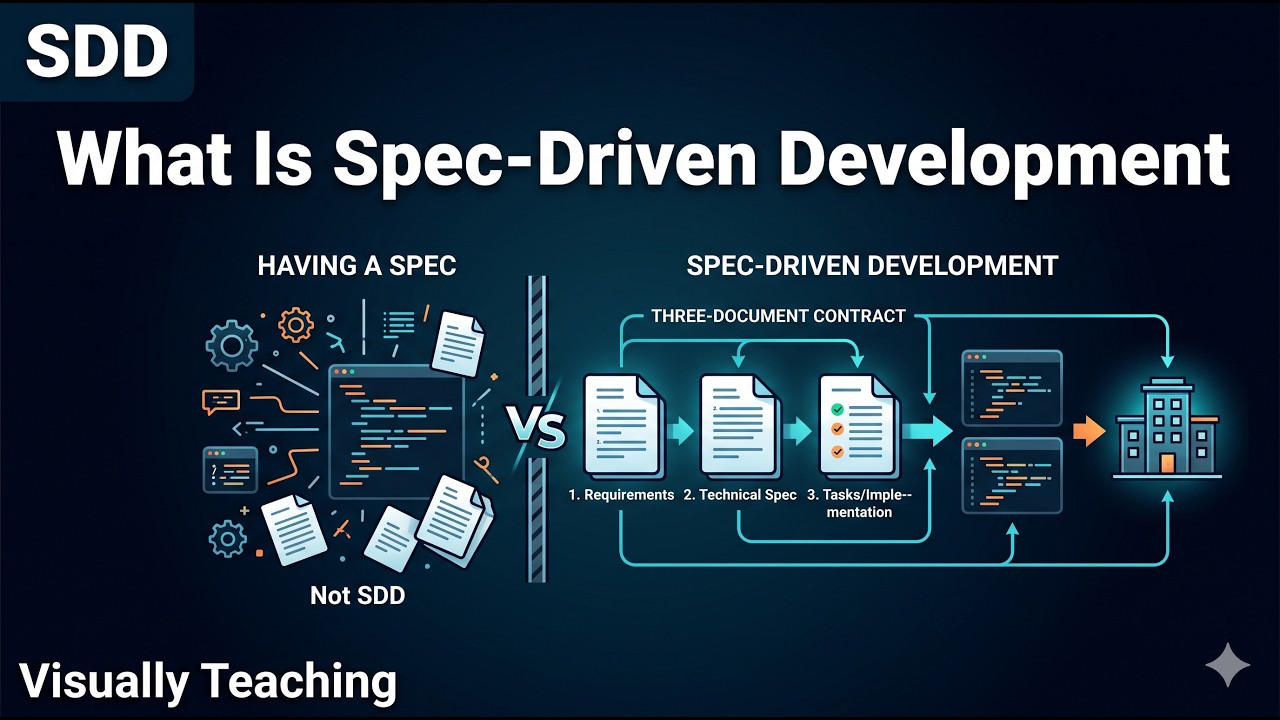
What Is Spec-Driven Development - Kiro · Spec Kit · BMAD | Complete Visual Guide #2
ByteLearn-RK2 months ago
Capabilities
Key features
Code Assistant
Helps you write, explain, and fix code directly inside your editor
Agent Builder
Builds autonomous AI agents that plan and execute multi-step tasks for you
Developer Tools
Provides utilities that help programmers build, test, and ship software faster
Workflow Management
Automates multi-step processes and routes tasks across your tools and team
The honest take
What users love & flag
Distinct themes surfaced across 10 reviews from 1 source — each grounded in real review text, ranked by how often it comes up.
Questions
Frequently asked
What is Kiro?
Kiro is a spec-driven development platform that transforms chaotic AI coding into structured workflows. Instead of relying on prompts and hoping for the best, it converts ideas into clear specifications and architectural designs, then implements them using parallel agents with property-based testing to ensure production-ready code.
Is Kiro free to use?
Yes, Kiro offers a free plan with 50 credits and access to open-weight models plus Claude Sonnet 4.5. Paid plans range from Pro at $20/month (1,000 credits) to Power at $200/month (10,000 credits), with premium model access and additional credits available at $0.04 each.
What makes Kiro different from other AI coding tools?
Kiro focuses on spec-driven development rather than "vibe coding" with random prompts. It creates structured specifications and architectural designs before writing code, uses parallel agents for implementation, and includes property-based testing that catches edge cases across all possible inputs, not just basic unit tests.
What platforms can I use Kiro on?
Kiro is available through three interfaces: a desktop IDE based on Code OSS, a command-line interface for terminal workflows, and a web interface for browser-based development with cloud sandboxes. It's accessible on web, iOS, and Windows platforms.
What is property-based testing in Kiro?
Property-based testing in Kiro goes beyond traditional unit tests by using automated reasoning techniques to verify that code behavior matches specifications across all possible inputs. This approach helps catch edge cases that might be missed by conventional testing methods.
How does Kiro's credit system work?
Kiro uses a credit-based pricing model where simple prompts consume less than 1 credit while complex tasks cost more. The free plan includes 50 credits, paid plans range from 1,000 to 10,000 credits monthly, and additional credits can be purchased at $0.04 each.
What programming languages does Kiro support?
Kiro supports over 500 popular programming languages and CLIs, making it suitable for diverse development environments and complex enterprise workflows. It integrates with development standards like Agent Client Protocol (ACP), AGENTS.md, and Model Context Protocol (MCP).
Can Kiro integrate with my existing development workflow?
Yes, Kiro integrates with GitHub and GitLab repositories for collaborative development and supports CLI automation in CI/CD pipelines. It's built on AWS infrastructure with enterprise features including centralized billing, SSO authentication, and usage analytics.
Compare Kiro
Compare with another toolMore Like This
