Low confidence — this score is based on limited public data (mostly aggregate ratings, with little independent discussion or review detail), so it may not reflect real-world quality.
What it is
Overview
Code-Graph-RAG builds knowledge graphs from codebases across 14 programming languages, then lets you query the structure in natural language. A hybrid build that uses tree-sitter parsing to map code relationships — functions calling functions, class hierarchies, import dependencies — into a queryable graph. Software developers and technical leads use it to understand large codebases without reading through thousands of files manually.
At a glance
Usability & Quality overview
Best for
- multi-language codebase querying
- knowledge-graph-based code exploration
- RAG-assisted code understanding
Watch out for
- Sparse independent user evidence
- Unclear real-world adoption from available discussions
Real product, not a wrapperIndependent product
This tool offers genuine innovation by parsing codebases from 14 programming languages into searchable knowledge graphs, automating the workflow from code analysis to natural language queries, and providing specialized integration with development tools through MCP (Model Context Protocol).
Strong evidenceQuality score
Code-Graph-RAG builds knowledge graphs for natural-language codebase analysis.
This score is our editorial judgment, computed automatically from the sources, weights, and dates shown above. It reflects the data we could verify as of August 10, 2026, not a guarantee or statement of fact about Code-Graph-RAG. Third-party ratings and quotes belong to their original platforms and authors. Thin data lowers our confidence label, and we say so instead of guessing. Work on Code-Graph-RAG? Dispute any datapoint and we will review it, publish your response, and correct verified errors.
Plans
Pricing
How free is free?
Genuinely free
Open-source with full features; paid tiers add hosting & support
What you get for free
- Full codebase analysis for all 14 supported languages
- Knowledge graph generation and export
- Natural language & semantic search
- AI code editing capabilities
- Structural search & replace
- Dead code detection
- Python SDK and MCP server integration
Behind the paywall
- Cloud-hosted graph database & agentProfessional
- Priority email support with SLAProfessional
- Custom language supportProfessional
- On-premise & air-gapped deploymentEnterprise
- Custom graph relationships & edge definitionsEnterprise
Watch & learn
Video content
YouTube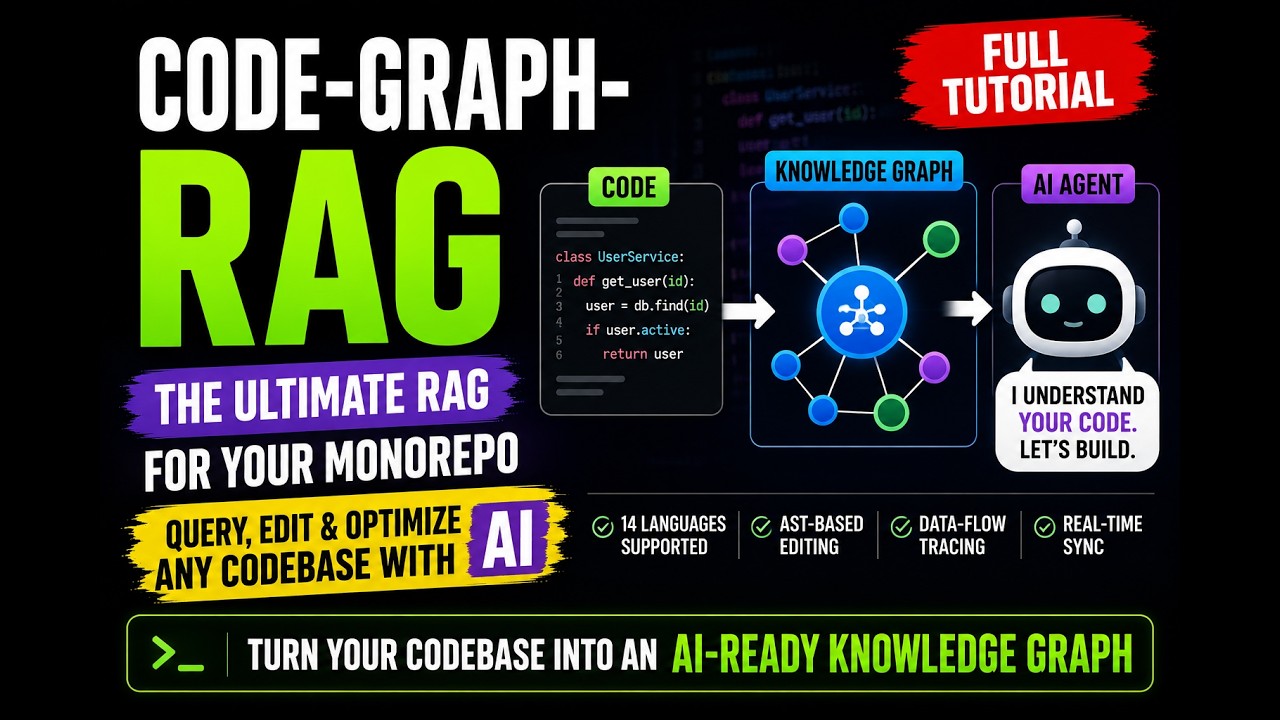 YOUTUBE198 views
Code-Graph-RAG : Query, Edit & Optimize Any Monorepo with AI + Knowledge Graphs
full_stackYT2 months ago
 YOUTUBE2 views
Code-Graph-RAG 지식 그래프
StudioWhatHappened2 months ago
Capabilities
Key features
Knowledge Graph
Maps entities and relationships from your data into a connected knowledge graph
Developer Tools
Provides utilities that help programmers build, test, and ship software faster
The honest take
What users love & flag
Distinct themes surfaced across user reviews — each grounded in real review text, ranked by how often it comes up.
Questions
Frequently asked
What is Code-Graph-RAG?
Code-Graph-RAG is a tool that builds comprehensive knowledge graphs from multi-language codebases using Tree-sitter parsing. It allows developers to query, edit, and optimize their code with natural language through AI-powered graph analysis, addressing the challenge of understanding large, complex codebases across multiple programming languages.
Which programming languages does Code-Graph-RAG support?
Code-Graph-RAG supports 14 programming languages including Python, TypeScript, JavaScript, Rust, Java, C/C++, and Go. It uses Tree-sitter grammars to parse source code across all these languages and constructs a unified knowledge graph that captures relationships between functions, classes, imports, and dependencies.
How does the natural language querying work?
Users can input natural language queries like 'What functions handle authentication?' and Code-Graph-RAG's AI translates these into precise Cypher graph queries. The system uses the knowledge graph stored in Memgraph database to understand code relationships and provide accurate results based on the semantic structure of the codebase.
Is Code-Graph-RAG free to use?
Yes, Code-Graph-RAG offers a free Community edition under MIT license with full feature access. This includes multi-language parsing, knowledge graph generation, natural language queries, structural operations, and MCP server integration with Claude Code, with community support via GitHub.
What is MCP server integration and how does it work with Claude Code?
Code-Graph-RAG includes MCP (Model Context Protocol) server capabilities that provide 15 specialized tools for Claude Code integration. This allows developers to leverage the knowledge graph analysis directly within Claude Code, enhancing the AI assistant's understanding of codebase structure and relationships.
Can Code-Graph-RAG detect dead code in my project?
Yes, Code-Graph-RAG can detect dead code through call graph analysis. It analyzes reference relationships within the knowledge graph to identify unused functions, classes, or modules, helping developers clean up their codebase and improve maintainability.
What makes Code-Graph-RAG different from regular code search tools?
Unlike text-based code search tools that rely on text matching or basic AST queries, Code-Graph-RAG maintains semantic relationships in a graph database. This enables complex queries about code structure, data flow, and architectural patterns, and includes features like data-flow tracing with FLOWS_TO edges that track values from sources to sinks.
What enterprise features are available for large organizations?
The Enterprise tier includes custom graph relationships for compliance mapping, on-premise and air-gapped deployment options, custom development services, and dedicated account management with SLA-backed response times. It also offers integration consulting, on-site training workshops, and architecture review services.
Compare Code-Graph-RAG
Compare with another toolMore Like This
