
What it is
Overview
A terminal-based AI coding assistant that maps your entire codebase and generates code changes through chat commands. Built as a wrapper connecting to Claude, GPT-4, or local models across 100+ programming languages. The 440K monthly visits skew heavily toward software developers who prefer command-line workflows over IDE extensions. Users describe fast code generation with automatic Git commits as the primary draw.
At a glance
Usability & Quality overview
Best for
- developers who prefer terminal-based workflows
- projects requiring Git-integrated AI changes with easy undo
- teams using multiple LLMs including local models
Watch out for
- terminal-only interface may not suit GUI-first developers
- limited documentation on advanced Git workflows in search results
- few organic user reviews to confirm long-term reliability
Frontier model
Powered by GPT 5.6 Sol (xHigh) — #20 ranked AI overall
▼ 3 in 30dupdated 2026-10-1098/100
smarter than 97% of ranked models
Also runs: Claude Opus 4.8 #40 DeepSeek V4 Pro #62 llama-3-70b-instruct #303 llama-3-8b-instruct #334
Arena Scores adapted from the LMArena leaderboard dataset, © LMArena, CC BY 4.0
Quality score
Aider A terminal-based AI pair programmer with strong Git integration and multi-LLM support, but limited GUI compared to Cursor-like tools
This score is our editorial judgment, computed automatically from the sources, weights, and dates shown above. It reflects the data we could verify as of July 20, 2026, not a guarantee or statement of fact about Aider. Third-party ratings and quotes belong to their original platforms and authors. Thin data lowers our confidence label, and we say so instead of guessing. Work on Aider? Dispute any datapoint and we will review it, publish your response, and correct verified errors.
Plans
Pricing
How free is free?
Genuinely free
Open-source tool; bring your own LLM API key
What you get for free
- Complete open-source AI pair programming tool
- Terminal-based interface with git integration
- Support for 100+ programming languages
- Voice command support
- Codebase mapping and context awareness
Community feedback
Aggregated reviews
Ratings and quoted comments below are aggregated from third-party sources and reflect those users' views, not SearchTools.ai's.
What reviewers talk about
themes inside the Sentiment pillar — not score ingredients
68Output Quality21 mentions
“After using Aider for a few weeks, going back to co-pilot, roo code, augment, etc, feels like crawling in comparison. Aider + the Gemini family works SO UNBELIEVABLY FAST. I can request and generate 3 versions of my new feature faster in Aider (and for 1/10th the token cost) than it takes to make one change with Roo Code. And the quality, even with the same models, is higher in Aider. Anybody else have a similar experience with Aider? Or was it negative for some reason?”
“So, I have been trying to use aider as a pair programmer tool with Qwen3 models, but it is just a disaster. Editing files without asking for permission, creating new duplicate folders/files... it just mess with the whole project. Does anyone have an open-source alternative to it?”
“Use it every day and sing it's praises to all who will listen, this tool generates 90% of my Sonnet and O3 traffic the only real downside is strong/fast models cost a few dollars a day. For professional devs it's a no brainer.”
“Aider clicked for me once I realised it commits each change as its own git commit, so the model's work is reviewable and revertable like any teammate's. Being model-agnostic means I can point it at whatever is cheapest or strongest that week. It rewards discipline: feed it the right files with /add or it burns tokens guessing. For terminal-first, git-native AI coding it is hard to beat.”
53Value & Pricingthin data · 6 mentions
“After using Aider for a few weeks, going back to co-pilot, roo code, augment, etc, feels like crawling in comparison. Aider + the Gemini family works SO UNBELIEVABLY FAST. I can request and generate 3 versions of my new feature faster in Aider (and for 1/10th the token cost) than it takes to make one change with Roo Code. And the quality, even with the same models, is higher in Aider. Anybody else have a similar experience with Aider? Or was it negative for some reason?”
“I'm temporarily switching to Cursor for practicality and cost savings. I love Aider and have been using it as my main AI coding assistant. I tried Cline (Claude Dev) as well. In both tools, I had to use tricks to try not to use $20 in 2 days. They work well for small projects. In Aider, you'll have to limit the context and constantly check /tokens for the token count, in combination with /clear and/or /reset when you're done with a piece of work. In Cline you have to open new chats frequently. I”
“Use it every day and sing it's praises to all who will listen, this tool generates 90% of my Sonnet and O3 traffic the only real downside is strong/fast models cost a few dollars a day. For professional devs it's a no brainer.”
“This is great and so efficient too, only really using a couple thousand tokens per transaction. Thanks 👌😎”
58Ease of Use19 mentions
“--watch-files parameter saved the tool for me. It feels more natural to work in the code then when I need AI, I inline a comment and aider will write the rest. e.g. I don't have to lift my hand to use the mouse, highlight some code, right click to popup a chatbot menu and ask the LLM--I just inline the comment, save the file and aider will do the rest. # Why isn't this working, fix it for me ai! def add_two_numbers(a, b): return a - b And aider will use the LLM to fix the code. Caveat: if you do”
“I am experimenting with both Cursor and Aider and find them great, but it is difficult to review changes coming from Aider. I came up with the following solution, it is a little bit of work, but utilizes the traditional PR review mechanics. If you have your project hosted ex. on Github, create a feature branch, let the aider do the work with the auto-commits on, then push the branch and create a PR. You can easily review the diff similar to what cursor does, and let the aider follow up on any ne”
“I strongly prefer aider exactly because it's not tied to an editor. Having to switch editors to use an LLM for coding isn't a serious option. And it's not tied to an LLM either. Gemini overtaking Claude? Just a pref flip away. Compare this to having to switch your entire IDE around. LLM stuff isn't mature enough for this kind of commitment.”
“Aider clicked for me once I realised it commits each change as its own git commit, so the model's work is reviewable and revertable like any teammate's. Being model-agnostic means I can point it at whatever is cheapest or strongest that week. It rewards discipline: feed it the right files with /add or it burns tokens guessing. For terminal-first, git-native AI coding it is hard to beat.”
Watch & learn
Video content
YouTube![This AI Tool Replaces Claude Code & is Free [Aider]](https://i.ytimg.com/vi/5zPckD0uwrM/maxresdefault.jpg) YOUTUBE5.6K views
YOUTUBE5.6K viewsThis AI Tool Replaces Claude Code & is Free [Aider]
The-Stack-ai3 months ago
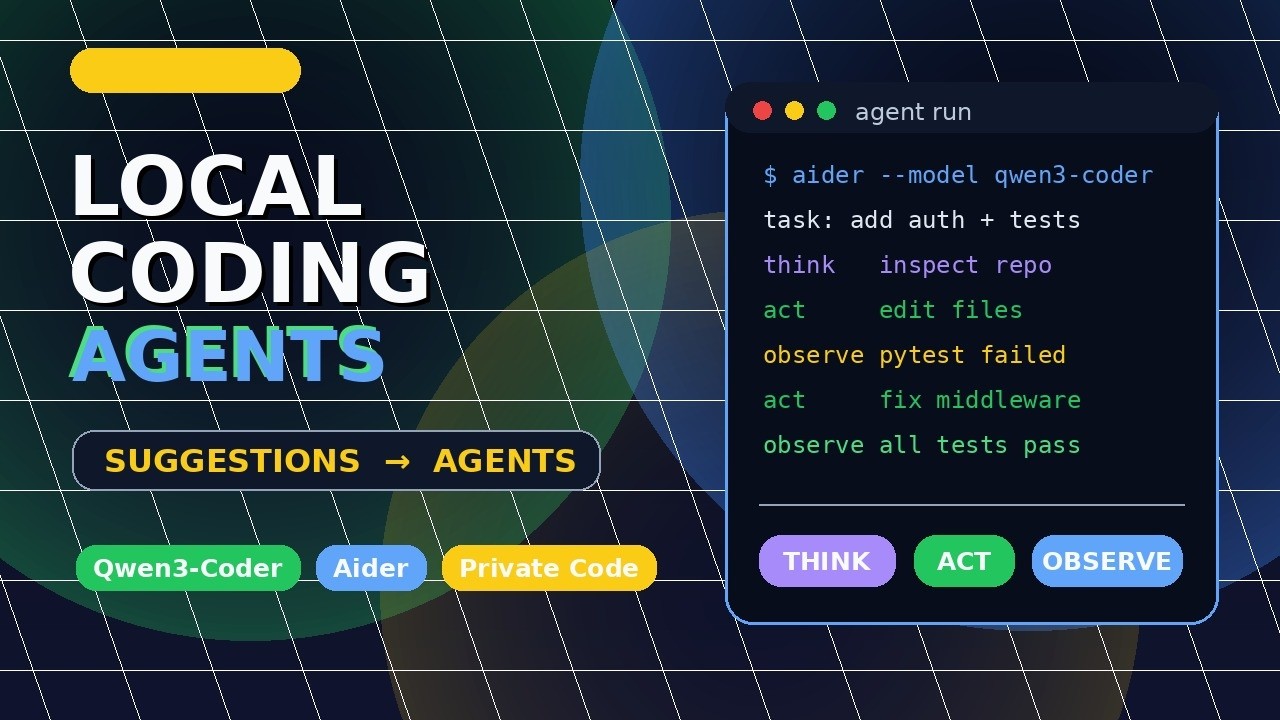 YOUTUBE28 views
Agentic Coding with Local LLMs: From Autocomplete to Autonomous
AIdeepdive-x8i3 months ago
Capabilities
Key features
Code Assistant
Helps you write, explain, and fix code directly inside your editor
Developer Tools
Provides utilities that help programmers build, test, and ship software faster
Speech to Text
Converts spoken audio into written text in real time or from recordings
The honest take
What users love & flag
Distinct themes surfaced across 1 reviews from 1 source — each grounded in real review text, ranked by how often it comes up.
Questions
Frequently asked
What is Aider?
Aider is an AI-powered pair programming tool that works directly in your terminal. It connects to various LLMs like Claude, GPT-4, and local models to help with coding tasks while mapping your entire codebase for context-aware assistance. The tool integrates with git and supports voice commands across 100+ programming languages.
Is Aider free to use?
Yes, Aider is free and open-source. You can install it via pip using the command 'python -m pip install aider-install'. However, you'll need API keys for cloud LLM services like Claude or GPT-4, which have their own pricing.
How does Aider's codebase mapping work?
Aider creates a comprehensive map of your entire codebase to understand project structure and relationships between files. This allows it to provide context-aware suggestions that consider your whole project rather than just individual files, making it particularly effective for larger codebases.
What programming languages does Aider support?
Aider supports over 100 programming languages including Python, JavaScript, Rust, Ruby, Go, C++, PHP, HTML, and CSS. This broad language support makes it versatile for developers working across different technology stacks.
How does the voice-to-code feature work?
Aider includes voice command functionality that allows you to speak your coding requests instead of typing them. The tool converts your spoken instructions into executable code implementations, enabling hands-free coding assistance directly in your terminal.
Does Aider automatically handle git commits?
Yes, Aider automatically integrates with git by creating commits with sensible commit messages for all AI-generated changes. This ensures that all modifications are properly tracked and reversible, maintaining good version control practices throughout your development process.
Can Aider test and lint code automatically?
Yes, Aider automatically lints and tests code changes to help maintain code quality standards. This built-in quality assurance helps ensure that AI-generated code meets your project's coding standards and passes existing tests.
What LLMs can I use with Aider?
Aider supports multiple LLMs including Claude 3.7 Sonnet, DeepSeek R1 & Chat V3, OpenAI o1, o3-mini & GPT-4o, and local models. This flexibility allows you to choose the AI model that best fits your needs and budget.
Can Aider process images and web pages?
Yes, Aider can process images and web pages as additional context for coding tasks. This feature allows you to provide visual references or web-based documentation that the AI can use to better understand your requirements and generate more accurate code.
Compare Aider
Compare with another toolMore Like This
